
Magicicada septendecim was the periodical cicada featured
in my last post, but that’s not the only 17-year cicada species who’s been singing.
There’s another species that looks like a slightly smaller version of
septendecim, but sounds completely different. If you think you won’t be able to
tell the difference, I can assure you right now: you will.

Now you classically-trained singers will assume this is
pronounced, “Ca-SEE-nee.” So will any Italian speakers. But, no: it’s
pronounced “CAS-sih-nye.” I still don’t understand how church Latin and
scientific Latin can be so different, but I have adapted.
Let’s get right to their calling songs. Here’s a recording
with both Magicicada septendecim and Magicicada cassini.
Septendecim is the chorus up in the trees with the
relatively steady pitch.
Cassini has a series of metallic “tics” and then a very loud buzz
that may remind you of an electric string trimmer or a weed whacker. Although they may fly or walk along branches and twigs when
they make their “tic” sounds, they stay in place on a perch when singing the
loud portion of their song.This cassini was moving between perches, and singing at each new location.
One of the very interesting things about the cassini chorus
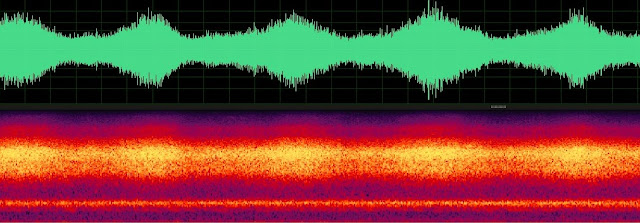
is that the sound swells and ebbs, then swells again – almost like an inhale
and exhale. (This is visible on the sonogram below.) I tried coordinating my breathing with the cassini chorus swells,
and it worked pretty nicely! There are septendecim in the background of this recording, but the sizzling cassini sound is more prominent. It's what you'll find noticeable in the sonogram below.

When the Brood V periodical cicada emergence began in NE Ohio, I heard septendecim songs before those of the cassini. Cassini emerged shortly thereafter, singing within a week after the septendecim had begun. I was immediately fascinated, as I'd only recently learned that there was more than one Magicicada species and the songs would be significantly different.
In my brief experience with periodical cicadas, the septendecim are generally higher in the trees and are likely to be in the woods and at the wood edges. I hear cassini in edge habitat and in individual landscape trees or large shrubs. Although they're occasionally in taller trees, I seem to be more likely to find them lower down...and closer to my ears.

Cassini look very similar to septendecim, but they are a little smaller. The size difference is obvious when both species are seen together.
In addition to the septendecim/cassini song difference and
size difference, cassini have black abdomens instead of the yellow-orange
stripes of the septendecim.


Their heads are completely black, while septendecim have an
orange stripe between the eye and the top of the wing.


Both cassini and septendecim have red eyes and three
additional tiny red eyes in between the two prominent ones.


Their behavior is different as well. Septendecim seem rather
placid when compared with cassini. They are content to sit on my finger for
extended periods of time, riding around on my hand until I make a serious
effort to convince them to perch on a plant instead.


Cassini, however, generally are not interested in hanging out with me. They might agree to sit on my finger for a minute or two, but are just as likely to tell me, “absolutely not!” They are pugnacious in a way that septendecim are not, and are quick to complain loudly and fly off.
(I’ve seen contrasts like this in katydids. When I spot a
singing Sword-bearing Conehead, he is likely to gradually slip downward
into the grasses or look at me as if to say, “Please don’t eat me.” A Round-tipped
Conehead will say, “Oh, HELL no!” and promptly, assertively fly away. No endearing
perching on my hand for those coneheads!)


Let’s compare the two Magicicada species' songs – and our perceptions of them –
more closely.
First, septendecim songs are much lower in pitch and
actually sound like they HAVE pitch, as I described in my last post, Pharaoh of the Cicadas. I can identify the prominent pitches, and each song has
a bit of a drop off in pitch and in loudness at the end. The song definitely sounds louder and a little more harsh and strident when a septendecim is close to me, but it doesn’t begin to approach the intensity of the
cassini song.
In the sonogram below, the septendecim song is clearly visible at the bottom of the sonogram. Its vertical position indicates how high or low the pitch is. Since it appears below the broad band of cassini sound, this tells us that it is lower in pitch than the cassini songs.

In the sonogram below, the septendecim song is clearly visible at the bottom of the sonogram. Its vertical position indicates how high or low the pitch is. Since it appears below the broad band of cassini sound, this tells us that it is lower in pitch than the cassini songs.

As you saw above, the cassini song is much higher: and is in a range that
sounds less like pitch and more like scratchy, crackling noise to humans. The
songs cover a wider frequency band, too, which results in a complex sound that
tends to sound like noise to us. I want to add, however, that I love
listening to their gloriously-abrasive “roar.” I just need to protect my
hearing when there’s a large chorus!
Here’s the solo cassini from earlier in the post, this time with a sonogram.


And are they actually louder? It certainly appears that way to me! When a cassini lands on my microphone and sings, I immediately have to drop the recording level to -18 or even -20 because of the overload. It also overloads my ears as well.

In fact, their choruses are so loud that I keep my
headphones on even when I’m not recording just to have a bit of a barrier
between their tymbals and my ears.


Like Magicicada septendecim, cassini have specific courtship
songs in addition to their calling songs. In this recording, a male cassini was
singing the typical calling song. However, a female that may have been interested
was nearby, so the male switched to a new song that was a little more complex
than the first. He then promptly switched to a series of slower, more
deliberate “tics.” I caught all of this on one recording in which is the same male made
all three of these consecutive songs.


The recording location, by the way, was a grocery store parking lot. It was the Heinen’s in Hudson, which is southeast of Cleveland and a little east of the Cuyahoga Valley National Park. There were huge numbers of cicadas in the ornamental shrubs and landscaping trees along the edge of the parking lot, and cicadas – mostly cassini – swarmed around them like bees. In addition, cicadas landed on my hair, my clothes, my gear, people’s cars, and the customers themselves. I thought it was quite amusing – especially when people tried to yell over the sound and kids shrieked as cicadas landed on them.
But alas! Brood V is fading away, and I’m quite sad about
it. I’d hoped to record the third species of periodical cicada – Magicicada
septendecula – but it’s relatively rare and time has just about run out. Sadly, I’m finding more
deceased cicadas every day. Although males are still singing, there is noticeably less song now. Most of the
mating seems to have already occurred.
 Many females have already oviposited (laid their eggs). I’ve watched many of
them and have seen the scars on twigs and branches.
Many females have already oviposited (laid their eggs). I’ve watched many of
them and have seen the scars on twigs and branches.


I’m now seeing “flagging” – the dead leaves at the end of
the branches and twigs where the eggs were deposited.


In several weeks, tiny nymphs will hatch out, drop to the
ground, burrow under the soil, and find roots on which to feed for the next 17
years. I’m not sure if I can wait that long, though! I’ve already checked the
periodical cicada brood maps and have noted that Brood VIII will emerge in far
eastern Ohio along the Pennsylvania line in 2019, there will be some from Brood
X in west/southwest Ohio in 2021, and Brood XIV in southwest Ohio in 2025. I’ve
quickly come to love these beautiful cicadas and cannot wait until 2033 to see
and hear them again.


