Showing posts with label Chipping Sparrow. Show all posts

Thursday, May 30, 2019

Dawn Chorus on a Sheep Farm


Have you heard of the Dawn Chorus events that are common in Britain? I certainly hadn’t until recently. They take place in May in bird-friendly habitats such as parks. People gather outdoors in the darkness, listening from the very first birdsong of approaching dawn until the full chorus has begun to sing after sunrise. Sometimes the participants then have breakfast together. It sounds delightful, doesn’t it?


From what I’ve been able to find online, the tradition began in England in the 1980s, spread across the rest of the U.K, then expanded to other parts of Europe as well. There is now an annual International Dawn Chorus Day on the first Sunday of May, and it’s been celebrated in over 80 countries! 


Betsy Stebbins-Anderson searched the internet for indications of International Dawn Chorus Day in the U.S. but didn’t find any. It was time. A family member who was an avid birder had done her own personal Dawn Chorus morning each May for 20 years until the end of her life, and Betsy decided to continue the Dawn Chorus morning here in Ohio.


The location would be on the family’s 186-acre Summerhill sheep farm near Shreve (a little south of Wooster). Betsy had contacted me about being the birdsong guide, and I thought it was an intriguing idea. And yes, there would be an outdoor breakfast for everyone after sunrise. Following breakfast, I would then lead a morning birdsong listening hike through various habitats on the farm. 


Although there was some distant sound from agricultural equipment on a neighboring farm when we arrived, it was still much quieter than most places I try to record. Walking up the hill from the sheep, I noticed that the songs hurled back and forth between the Chipping Sparrows seemed to sparkle! Was I able to hear more of their highest frequencies than usual?  And the Red-winged Blackbird’s screams - always quite bellicose - were even more potent than I would have expected. 


Look at the sonogram: you’ll see the high, steady trills of the Chipping Sparrows and the lower hooked-shaped screams of the Red-winged Blackbird. The latter species has a number of different calls, and I suspect that each one is either a threat or vulgar insult.


The view up on the hill at sunset created a sense of space inside me as well as around me, and I would have liked to have stayed outside well after dark. However, Wendy and I would be getting up at 4 AM - unimaginable for a night person like myself – and ready to communicate with other humans by about 4:30. 


People began to gather even before 5:00, and the earliest arrivals were the ones who heard the first birdsong of pre-dawn. You’re probably thinking it was a Robin, or maybe a Cardinal, but no - it was a Song Sparrow at 4:45. He was followed a 5:02 by a Chipping Sparrow, and only at 5:06 did the first Robin take the stage.


Soon, more Robins began to sing, followed by Barn Swallows, a Field Sparrow, Killdeer, Northern Cardinals, and a Chickadee. (Although Summerhill Farm is in the overlap zone between Black-capped and Carolina Chickadees, this one was singing the Black-capped song.) 


We quietly walked on the narrow road along the edge of the farm and were soon challenged by the number of bird species beginning their dawn songs. Wendy kept the list as we softly announced the name of each new singer.

Just the Catbird, Tufted Titmouse and House Wren together sounded like a chorus! I'll focus on each one in this track so you can get a better idea of who is singing. The sonogram is primarily the Catbird.


Behind the wall of Robin song, I heard a Field Sparrow singing an atypically complex, three-part song that I’ve occasionally heard elsewhere. Later in the morning, this Field Sparrow and any others we heard were singing the expected accelerating trill. Here’s an example of the early morning song.


We'd all heard birds at dawn before, but our attentiveness and focused listening enhanced our sense of wonder. The birds revealed themselves with their songs; we didn’t actually see most of them. Songs and calls are how they communicate with each other, and we humans were just privileged listeners. 


By 6:52, we had heard 32 bird species - including a calling Sandhill Crane.


After a splendid breakfast, we returned to listening to the birds while walking under the morning sun. Other family members have houses on the farm and Carolina Wrens were happy to make their homes near them. If they are present you will certainly hear them. 


Unlike House Wrens, Carolina Wrens do not migrate and need to manage Ohio winters. While less common in the snow belt counties of NE Ohio (though increasing in numbers as winters become milder) they seem to be plentiful south of Cleveland.


I didn’t expect our walk to take us down through a large field and into a woodland.  The bird songs we heard quickly changed to a new habitat-specific ensemble. A woodland doesn’t sound like a meadow, and Summerhill Farm’s Savannah Sparrows and Eastern Meadowlarks would not be singing in the woods. 

Instead, we now heard the Red-eyed Vireo, Wood Thrush, Rose-breasted Grosbeak, Acadian Flycatcher, a Barred Owl calling…and what was that in the background near the small, wet opening in trees near the Yellow-throated Vireo’s song? Could it be a Cerulean Warbler? 


I was able to get closer, and it most certainly was a Cerulean - always a very nice discovery! I haven’t had many opportunities to hear them on territory.
But John and Betsy are very conscientious about caring for the habitats on the farm, so it is no coincidence that this rich chorus of woodland singers could be found on their property. Protecting habitats - the concert halls, as I sometimes describe them - protects the birdsong ensembles.  


Heat and humidity were increasing with the sun’s intensity as we headed uphill back toward the house past the Savannah and Song Sparrows. The Dawn Chorus morning was ending, but could it really be only 10:15? 


Before we left the farm, I had to pay one last visit to the sheep. I was still intrigued by the vocal variation and nuance in their calls and could hear each one as an individual more easily than I could ever visually recognize them. While you listen to my favorite recording of the lambs and sheep, you can read the list of birds we heard.


You can find Summerhill Farm on Facebook, where you can watch their page for other events like this one. Betsy plans to do the Dawn Chorus event annually. As for me, this lifelong night person would be delighted to get up once a year at 4 AM before returning to her nocturnal ways.


Except for the opening and closing sheep photos, the photos of the Dawn Chorus morning were provided by Summerhill Farm.

Tuesday, May 27, 2014

How many trills can you remember?


There’s certainly been a lot of changes in the avian chorus lately, and early migrants head north, later ones arrive and then move on, and summer residents begin to establish their territories.  Some of the bird song identification challenges have actually gotten easier, too, such as my topic today: trills.


In musical language, a trill is a rapid alternation between two adjacent pitches.  In the 17th century, a trillo was a rapid repetition of the same pitch. 


 “Trill” is also used to describe the songs of birds that alternate quickly between two close pitches AND those that simply repeat the same pitch very rapidly.   Sometimes the verbal description just can’t convey enough information to be truly helpful.  For many people, even listening to recordings of different trills that particular species can sing could be challenging because those trills may be sung at different rates of speed. Even if the entire length of the song is the same, it will sound faster to us if more notes are sung in the same amount of time. 


For example, here are three Chipping Sparrows.  Their song is described in the Peterson Field Guide to Birds of Eastern and Central North America as “…a dry, chipping rattle on one pitch.”  That description is accurate, but what if you didn't know that they can sing faster or slower versions of their song?  You could easily assume that these are different species.


And then there's the Dark-eyed Junco.  “Song a loose trill, suggestive of Chipping Sparrow but more musical.”  More musical in what way?  I think it's a little sweeter, more jingling, and sounds like it has a less dry, abrupt cutoff at the end. (How's that for subjective?) And this one, too, can be sung at different speeds!


In my third Junco example, there are two Juncos singing close to each other at the Holden Arboretum in April.  One is singing a faster song than the other, and one could easily assume that two different bird species were singing.


The Swamp Sparrow's song is “…a loose trill, similar to Chipping Sparrow’s but slower, sweeter, and stronger.”  In this recording, you'll also hear other birds of marshes and wetlands in the background.  


And what about the Pine Warbler? “Song a trill on one pitch like Chipping Sparrow’s song, but more musical, slower.”  The tone quality is different – it’s much richer.  However, a Pine Warbler’s song can actually be faster than a slow Chipping Sparrow or Junco song. 


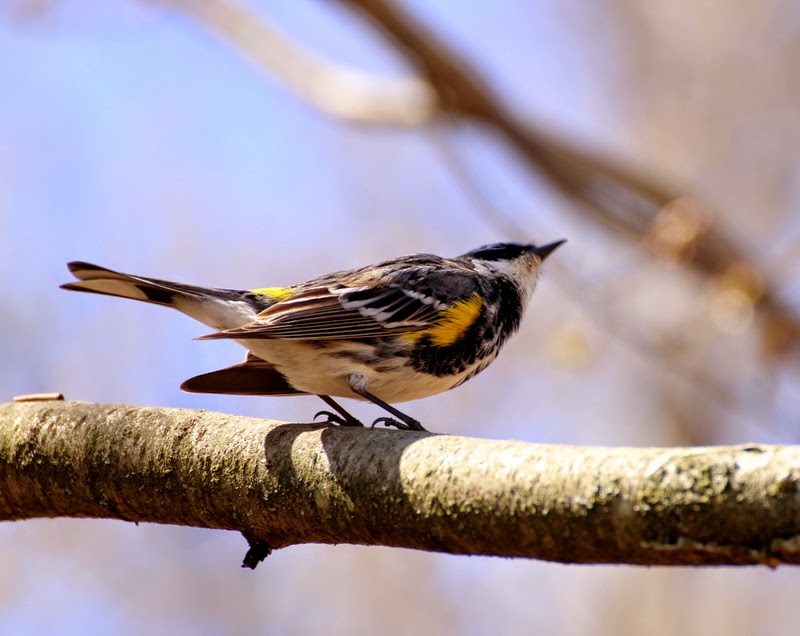
The Yellow-rumped Warbler also has a trilled song, and that one really is a little slower. It’s described as “Variable song, junco-like but two-part, rising or dropping in pitch, seet-seet-seet-seet-seet, trrrrrrr.”  However, sometimes it just sounds like a slower trill.  See what you think.


Here are Yellow-rumped and Pine Warblers singing very close to each other in April at Tinkers Creek State Nature Preserve in Portage County.  The Pine Warbler’s trill sounds  faster and more dense – there’s more sound and less space between the notes.  The Yellow-rumped Warblers are singing either a slower trill with a bit more space between the notes or the slightly more variable song described in the Peterson field guide.   


When I was standing near the edge of the ponds with pines trees just behind them, though, I had to really concentrate and think this through to be sure I really understood the difference between the songs.  They didn't generally sing one at a time so I could compare and contrast.  Not at all.  They overlapped, they sang simultaneously, and the Yellow-rumpeds sang two different forms of their song.  The quiz came before I could even study the material. 


When you’re first learning these songs, though, you don’t have to memorize all of the trills and compare them all to each other.  There’s an easier place to start.


Habitat and season.  Narrow down your choices.  You won’t hear all of these birds together at the same time in the same place.  Keep it simple.

Which of these trilling singers will be performing together on the same stage?  Unless it’s April, most will not.  I often consult Larry Rosche’s Birds of the Cleveland Region, published by the Cleveland Museum of Natural History.  I find this book to be invaluable for knowing when to expect specific species in our area and in which habitats they can be found.

Chipping Sparrows return in April, and they are common in open areas that have a scattering of trees.  They love golf courses, cemeteries, developments, campuses, and meadows with occasional trees, including evergreens.

Juncos are generally more northern birds that spend their winters down here in balmy Ohio.  They begin to sing in late March in advance of their departure, and many more Juncos from farther south sing as they pass through on their way north.  By the end of April, they’re gone EXCEPT for the NE corner of the state.  There, Juncos nest in hemlock ravines and other cool, wooded areas from the Chagrin River valley in eastern Cuyahoga County eastward through Lake, Geauga, Ashtabula, parts of Summit County, and surrounding areas.  Some have even begun to nest closer to people.  They will not typically be found with the Chipping Sparrows, though, as the latter are likely to be in more open areas and are commonly found closer to humans.

Pine Warblers return in April and, not surprisingly, they sing in pines – not a solitary pine or two in an open, developed area, but in a grove or forest of pines.  


The Yellow-rumped Warblers will be gone after April, so you won’t need to worry about sorting them out of the texture after the beginning of May. 

And Swamp Sparrows?  A few may stay here during the winter, but you probably won’t hear them singing before April.  And where will they be singing?  Marshes.  Where are the Juncos and Chipping Sparrows and Pine Warblers?  Exactly.  You’ve got it.  Just watch at the edges of their habitat, though. I once found a Chipping Sparrow singing its slow song near the edge of a marsh and would have assumed it was a Swamp Sparrow had I not investigated closely.


Only in April does it really get messy,  Juncos and Chipping Sparrows are quite likely to be singing together for a brief period of overlap, and if they’re in an area with pines there may be Pine Warblers as well. The Pine Warblers in the pines near the ponds, as at Tinkers Creek State Nature Preserve,  may be singing next to the Yellow-rumped Warblers in the deciduous trees bordering the pond while Swamp Sparrows sing in the nearby marsh. 

Once May gets established, it becomes much easier.  Remember that both Chipping Sparrows and Juncos can sing trills that are fast, slow, or in between, and consider the habitat where you're hearing the trilled song. Listen closely to the Chipping Sparrows, Pine Warblers, Swamp Sparrows and Juncos if you have then, and learn them in their contexts.  Then when everyone gets mixed together next April, you’ll be in a better position to sort them out. 

Oh, and about that first track: Yellow-rumped Warbler, Swamp Sparrow, Chipping Sparrow, Junco, Chipping Sparrow, Junco, Pine Warbler, and...another Chipping Sparrow.