It’s time for my annual “Crickets and Katydids in the
House” to close out another calendar year of Listening in Nature blog
posts. Although the indoor numbers are
diminishing as these elderly insects gradually fade away, we’ve had another
fascinating festival of singers this autumn.
As you can see, Nikos has been keeping an eye on the
singers and their mesh butterfly cages in the dining room. We have a pair of south windows there that
both orthopterans and felines enjoy.
Does Nikos present problems for the insects? Not typically.
In fact, I’ve repeatedly found him stretched out on their table next to their
mesh cages, sound asleep. They sing regardless of his proximity.
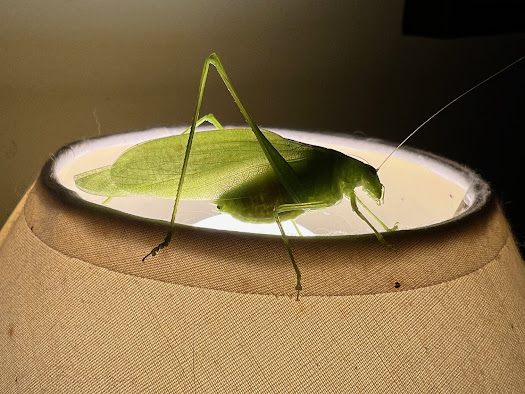
Our distinguished guest this year was Michael Microcentrum (Microcentrum
retinerve), a Lesser Angle-wing katydid from southern Ohio. This species is
moving north from southern and central Ohio but is not in my immediate region –
yet. I have recorded them as far north as the Cuyahoga Valley National Park in
Summit County (the county on Cuyahoga County’s southern border), so they’re
coming.
His song was a series of three quick, sharp, loud
exclamations followed by a pause, then another group of two or three
exclamations.Sometimes he really startled me!
Michael loved grape leaves, which I provided for as long as
possible.
I subsequently used an entire leaf of Romaine lettuce in a little
vase, which he found to be an acceptable substitute.
As with all the singers here, Michael
had a daily organic grape half and organic apple slice plus Fluker’s
cricket hydration cubes for water and dry cricket food. I also mist the mesh
lid of each cage nightly, and I’ve seen both Michael and occasionally tree
crickets immediately drinking the water drops.
This is a good size for tree crickets. Katydids need something larger
Michael Microcentrum with his grape and apple slice.
Grape leaves were challenging not only because their season
was gradually ending, but also because Nikos really wanted those large leaves.
One night when he was being especially obnoxious about trying to seize his
leafy prey, I put a large grape leaf on top of his head.
He stopped. The grape leaf seemed to be an immediate calming aid. He sat motionless with the grape leaf on his head for the next half hour.
Our two other katydids are gorgeous Black-legged Meadow Katydids (Orchelimum nigripes): one from Geauga County and one from Lake County. Black-legged Meadow Katydids are common along ponds and wetland edges and live quite comfortably in a larger mesh cage with plant cuttings and seed heads from their original locations.
The Lake County Black-legged has a cattail seed head in his cage, as
those were abundant in his area. There were no cattails anywhere near the
Geauga Black-legged's wetland. He lived in
bulrushes, and that’s exactly what he has now.
You’ll notice in my photos that the Geauga Black-legged’s
face is almost white while the Lake County Black-legged’s face is the rusty red
of his cattails. Is the color in some way determined by the habitat? I have no
idea.
Black-legged Meadow Katydid from Geauga County
Black-legged Meadow Katydid from Lake County
You may know the typical song of this species:
tic-tic-tic-and then a long whirr.

Nikos watching the Geauga Black-legged Meadow Katydid.
Both of these katydids tear into their Romaine lettuce!
It’s quite obvious – just look!
The Geauga Black-legged generally stays in my studio next
to my desk, as he becomes agitated and annoyed by the other Black-legged, who
lives in the dining room. That’s fine with me – how nice to have a Black-legged
Meadow Katydid singing right next to me while I’m at my desktop computer!
At times, he also sings several erratically-spaced
“tics” after his typical tic-tic-tic-whirrr.
Listen:
All the other residents in our Orthopteran assisted living
accommodations are crickets. Always common here are Forbes’s Tree Crickets (Oecanthus forbesi) and
the look-alike sound-alike Black-horned Tree Crickets (Oecanthus nigricornis). Black-horneds are more
common east of my region and Forbes’s are likely the species that is found west
of Cleveland. Because I live in NE Ohio, I’m in the overlap zone of these two
species and have been learning to separate them by song and habitat.
Black-horned Tree Crickets seem to be more likely to live
where there are shrubs and thicker vegetation rather than out in an open,
goldenrod-filled meadow. The latter habitat is a prime territory for Forbes’s
Tree Crickets.
There’s a difference in
the songs that I can hear in the field and also see on a sonogram. (Musicians:
it’s the second harmonic.) I can usually hear the difference in the tone
quality and subsequently see it on the sonogram. The distinction can be
confirmed by the number of wing strokes per second at a given temperature.
I love them all, of course, but I have a bit of a
preference for the Black-horned Tree Cricket’s tone quality. Here’s one from
Geauga County:
Both species are a delight to have at home! They sing
consistently and often seem quite confident or even downright bold. When I
unzip the mesh lid of their butterfly cages, they may run right up toward my hand
to see what I’m doing.
As these tree crickets age, their file and scraper song mechanisms
can begin to break down. We had a Forbes’s Tree Cricket - “Squeaky” - who provided an interesting and
very obvious example of how this might sound.
My favorite tree crickets are probably the larger, truly
gorgeous Broad-winged Tree Crickets (Oecanthus latipennis). They typically live in dense shrubs such
as dogwoods, viburnums, and blackberry, so the indoor habitats I create for
them always include blackberry cuttings. They often sing from the underside of
a leaf and will immediately hide underneath one if startled.
Broad-winged Tree Cricket on the underside of a leaf, as is often the case
The Broad-winged in this photo, however, was quite exposed as
he boldly sang near the top of the cage.
These tree crickets are one of the easier species to
identify in the field, as their songs are consistently at a lower pitch than
the nearby Black-horned, Forbes’s, or Four-spotted Tree Crickets.
I recorded
this example in the house: first, you'll hear Black-horned Tree Cricket. followed by a Broad-winged Tree Cricket. The Broad-winged Tree Cricket's subsequent entrance will be obvious.
For weeks, we had two of our favorite tree crickets
upstairs on a bedroom dresser every night: a Snowy Tree Cricket (Oecanthus fultoni) and a Four-spotted Tree
Cricket (Oecanthuis quadripunctatus). Yes, I know. We have multiple favorites.
We have Snowy Tree Crickets in our neighborhood, including our
backyard. Their steady, rhythmic songs are commonly heard along the Lake Erie
shore and also in old, inner-ring suburbs like ours.
This is one of our backyard Snowy Tree Crickets
One individual moved from the back of the yard to the
native honeysuckle trellis against the house as night temperatures got colder,
and I subsequently located him and brought him indoors. Next to him on the
dresser was the Four-spotted Tree Cricket, who could still sing his steady trill but just
had a little trouble getting warmed up at first.
Four-spotted Tree Cricket
Here’s a recording from the
bedroom in the dark. The Snowy is the first “voice” you’ll hear.
Of course, we always have a Handsome Trig or two or three (Phyllopalpus pulchellus).
These tiny crickets were never in our neighborhood until about 10 years ago but have now moved
north up to the lakeshore from down in Summit County. They eventually found our backyard and are now annual
residents.
And what about Nikos? When I needed to provide blackberry
cuttings for those crickets that required them, Nikos once again launched an
attack on the vegetation (but not the crickets). If a grape leaf could calm him
down, could a large blackberry leaf accomplish the same outcome?
****************************************************************************************************
You can read more about these crickets and katydids in my online field guide,