It’s Chickadee time again! Black-capped Chickadees,
Carolina Chickadees and everything in between.
Especially in between.
If you’ve been following this blog for a while, you know
I’ve written about both the Black-cappeds that live up in my area and – when I
can get down to visit them – the Carolinas who live south of Route 30.
I’ve also recorded chickadees from the species overlap zone, particularly those
at The Wilderness Center in Wilmot, Ohio.

There are hybrid chickadees at The Wilderness Center, and they have some very unusual songs, such as this one:

There are hybrid chickadees at The Wilderness Center, and they have some very unusual songs, such as this one:
I’ve recorded them for three years now, and I’ve continued hearing
their odd, delightful songs this spring. But what are the chickadees singing
elsewhere along the Route 30 line?
Late March through the first half of April seems to be a very good time for lots of chickadee song. Because this is after spring break but before the end of spring semester, it’s a challenge for me to get down to to their area at that time. I hope for good recording weather on the weekends; no wind, no rain, and certainly not wind and snow two Sundays in a row!
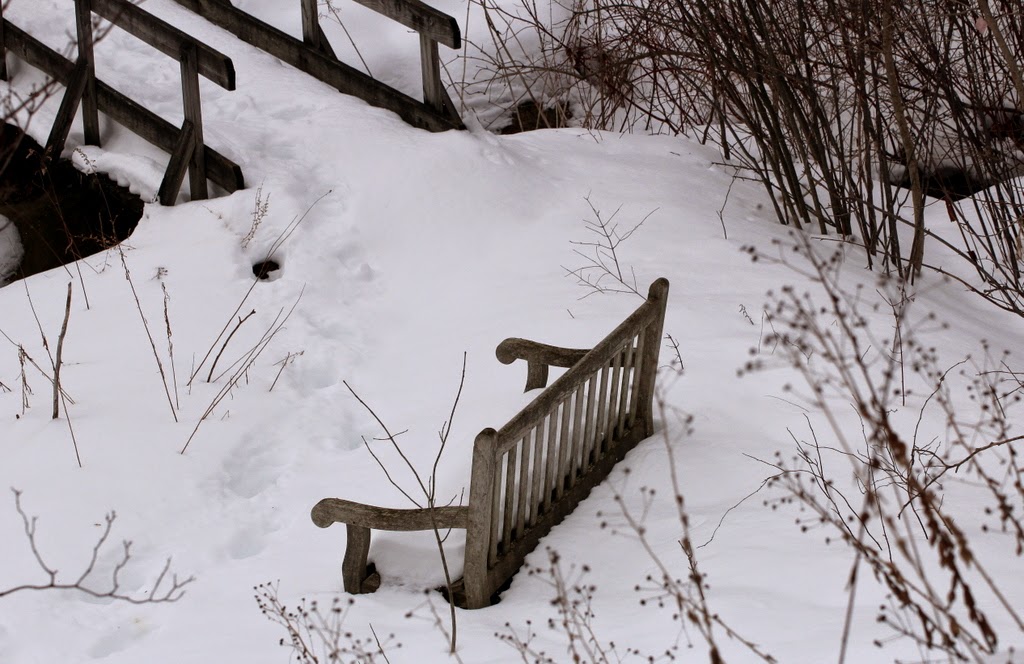
I thought maybe I’d leave snow behind when I drove south
from Cleveland, but Wooster was sharing our joy.

The resident chickadees certainly didn't care. It was time to
set up and defend territories, and verbal challenges were being hurled across
the road and the parking lot when I arrived at Wooster Memorial Park.
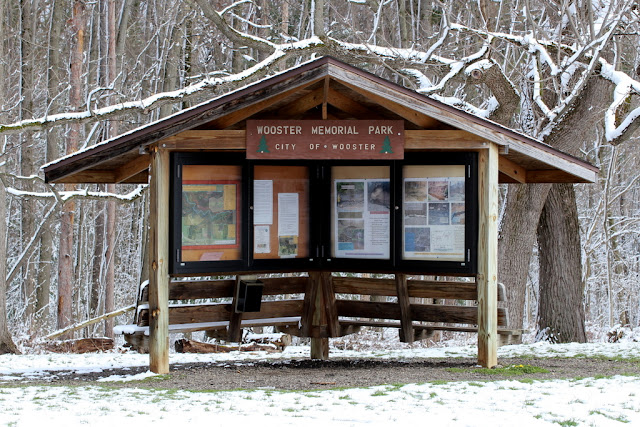

The park is just a bit past Route 250's split from Route 30. I came here to learn which species’ song or songs I would hear and if there were any songs like those I've heard at The Wilderness Center.
I was surprised to encounter more traffic noise than I would have imagined on a snowy Sunday morning (mostly a plethora of pickups), so recording conditions were considerably less than ideal. My primary goal was to listen and observe, but I did want to document whatever I heard.

When I opened the car door, I could not grab my recording gear fast enough – I heard three different kinds of song! In spite of the pickup parade, I had to capture whatever songs I could as quickly as possible while the birds were proclaiming their territorial boundaries.
Carolina Chickadee song right here!


But wait – here’s a Black-capped Chickadee song!


It sounded just a little odd, but it was definitely the
two-note descending major 2nd of the Black-cappeds – just a little faster than usual.
Hybrid Chickadees can sing the song of either species, and
here were both songs right in the parking lot!


And then…
One of those three-note songs that are the norm at The
Wilderness Center. This bird was screaming it out fast and furious, too!


All of this was happening within sight of my car.
What would I observe if they kept singing for a while and I
could listen to their interactions? I was not disappointed.
Actually, I was quite excited!
There was more than one form of four-note Carolina
Chickadee song. Here's the first one you heard earlier followed by the second one so you can hear the difference. In the first song, the first and third notes are both very high. In the second song, all four pitches are (to our ears) rather close together. You'll hear each song three times and see each one twice in the sonogram below. Keep in mind that all these chickadees - there were four of them - were all near the small parking area along the road.

In addition, the chickadee singing this Carolina song was being answered by a chickadee singing a three-note song. They were clearly singing back and forth at each other with different songs, and sometimes the first chickadee would shorten his four-note song so he, too was singing a three-note song. I was fortunate to be in the process of recording him when he did.

In addition, the chickadee singing this Carolina song was being answered by a chickadee singing a three-note song. They were clearly singing back and forth at each other with different songs, and sometimes the first chickadee would shorten his four-note song so he, too was singing a three-note song. I was fortunate to be in the process of recording him when he did.
He continued to alternate between three notes and four notes, while the second chickadee continued with his three-note song.

The chickadee across the road consistently sang a three-note song, but his
pitches were a little different from the primary three-note song on the park's side of the road.
However, when he was directly responding to the three-note songs in the parking lot, he altered his pitches to match those of his rival. I heard this happen, and you can hear it in the track below. Here's a sonogram with one example of each song.

However, when he was directly responding to the three-note songs in the parking lot, he altered his pitches to match those of his rival. I heard this happen, and you can hear it in the track below. Here's a sonogram with one example of each song.

There was so much to hear! If all I did was look,
every bird I saw appeared to be…a chickadee. Black-capped and Carolina Chickadees look very similar. In the overlap zone, it’s not reliably possible to distinguish them in the field. According to David Sibley in the online Sibley Guide, "In that area, chickadees are essentially unidentifiable, and observers
can only say that an individual bird 'shows the characteristics of' one
species or the other."
Their calls are similar, but the Carolinas are noticeably faster. I think these calls from Wooster sound more like Carolina Chickadees.
Their calls are similar, but the Carolinas are noticeably faster. I think these calls from Wooster sound more like Carolina Chickadees.
It’s the songs that are more distinctive.
What an exciting parking lot! The birds calmed down after a
little while, and my walk farther back into the woods was surprisingly quiet. Apparently, I’d timed it
just right when I arrived.
Sibley advises that "if you are lucky enough to live in or near the contact zone, the best way to familiarize yourself with each species is to take a field trip north or south into pure Black-capped or Carolina country. Studying birds of known species – and the variation within each species – will give you more confidence for identifying the chickadees in the zone of contact." That's one reason I go down to Columbus every spring when I can. (It's also warmer down there - none of that "cooler near Lake Erie" annoyance we experience up here in the spring.)
If you are interested in reading more about comparing Black-capped and Carolina Chickadees and about hybrid chickadees in the species overlap zone, I'd encourage you to read David Sibley's Distinguishing Black-capped and Carolina Chickadees. There's a wealth of information here, including the overlap zone map.
Reports on eBird indicate that Carolina Chickadees are being found north of Route 30, and those will be my next chickadee explorations. I'll keep you posted on what I hear...and don't hesitate to let me know what you hear as well!

Sibley advises that "if you are lucky enough to live in or near the contact zone, the best way to familiarize yourself with each species is to take a field trip north or south into pure Black-capped or Carolina country. Studying birds of known species – and the variation within each species – will give you more confidence for identifying the chickadees in the zone of contact." That's one reason I go down to Columbus every spring when I can. (It's also warmer down there - none of that "cooler near Lake Erie" annoyance we experience up here in the spring.)
If you are interested in reading more about comparing Black-capped and Carolina Chickadees and about hybrid chickadees in the species overlap zone, I'd encourage you to read David Sibley's Distinguishing Black-capped and Carolina Chickadees. There's a wealth of information here, including the overlap zone map.
Reports on eBird indicate that Carolina Chickadees are being found north of Route 30, and those will be my next chickadee explorations. I'll keep you posted on what I hear...and don't hesitate to let me know what you hear as well!