Showing posts with label Four-spotted Tree Cricket. Show all posts

Friday, January 3, 2025

Field Station Exploration

                                Field Station Exploration
                       (currently being edited and revised) 


  Hiram College field station, Portage County, NE Ohio


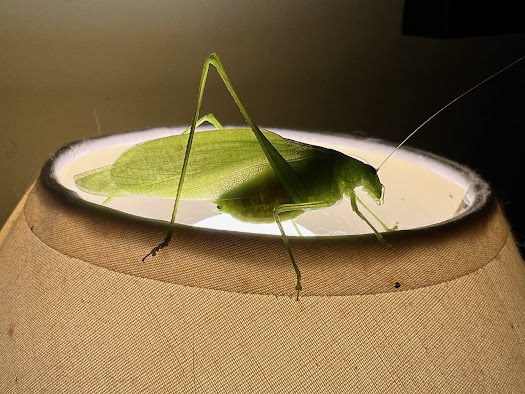
The ground is snow-covered now and there's a Lake Effect Snow Warning here in NE Ohio. My last surviving Broad-winged Tree Cricket finally passed away in December but my ancient Black-legged Meadow Katydid is still singing occasionally in his spacious mesh butterfly cage in the dining room. (If you read my preceding post, "The Prodigal Katydid," this katydid was the featured character in the story.) He no longer climbs up high in his cage, but he has a very nice array of foods arranged along its floor.


     Black-legged Meadow Katydid on 1-3-25.  On the left is his grape half, on the right are hydration cubes, and seeds from his bulrush seed heads are on the floor of his cage.


Although we have the inevitable traveling crowd of House Sparrows here at the moment, I’m focusing on all the other birds in our natural backyard and at our feeders. Still, I deeply miss my summer and early autumn afternoons and nights in the meadows, marsh edges, and shrubby woodland borders that are over half a year away.


Summer feels so distant now.


During that past 15 years that I've studied singing insects throughout NE Ohio, I’ve spent more time in Geauga County than anywhere else in NE Ohio and have also done surveys in Lake, Summit, Stark, Lorain, Medina, and Cuyahoga Counties. 

                                  Northeast Ohio - Wikitravel     

                                                           (Wikitravel.org)

I had visited three of the Portage County parks a number of years ago, but hadn't spent as much time in that county as I thought would be helpful to regionally connect Geauga to Portage to Summit.

But where would I be able to spend considerable time in this rural county?

Perhaps the 550-acre Hiram College Field Station in Portage County might be interested in my survey work. I didn’t know anyone there except their Education and Outreach Director, Mike Sustin, whom I’d previously met at other regional park districts. He cheerfully became my Hiram Field Station contact person. Field Station director Dr. Michael Benedict and the staff also welcomed me.

I couldn’t possibly explore the entire property in one summer and needed to target the areas that seemed most likely to have substantial numbers and diversity of singing insects. I also needed to consider what felt safe to explore during my typical nighttime forays.

There were shrubby meadows, woodlands and a large prairie within walking distance of where I parked my car. I would need to keep the trail options organized in my head, as it would be easy to become confused in the dark. 


Fortunately, Wendy (my wife) accompanied me first by day, then on my initial night exploration as I learned the trails. I found some landmarks – the occasional signs, the hanging grapevine dangling above the trail, an opening in the tree canopy…

As you probably know by now, I am drawn to meadows and prairies. They are the most productive places to search for crickets and katydids, and I cherish the openness and all that sky above me – especially at night.

Park district land managers are turning former farm fields into meadows and even prairies of native grasses.  Mike Sustin introduced me to Hils Vista, which is the prairie-in-progress at the Hiram Field Station. (It is named after professor of biology and former Field station director Matthew Hils. You can read more about the field station's Grassland Program here.)


The prairie was filled with big bluestem and other prairie grasses instead of the usual dense goldenrod meadows I love and know so well. It was gorgeous! 

Who might I find there?


As I walked farther down the long hill, meadow vegetation like goldenrod, ironweed, and Joe-pye weed began to dominate closer the bottom of the trail near Silver Creek.  Could I have both prairie grasses up higher on the hill and meadow vegetation farther down – and perhaps changes in the Orthopteran species along the extensive trail? Excellent!


July in NE Ohio is the time to look and listen for early katydids, with the first tree crickets joining them as the month progresses. The prairie grasses were perfect for the first Sword-bearing Coneheads in July.


                                    Sword-bearing Coneheads at the Hiram Field Station


I have been concerned in recent years about lower numbers than expected of Broad-winged Bush Katydids and even our previously abundant Curve-tailed Bush Katydids. Would I find them out here?  

Yes! The Broad-winged Bush Katydids were right on time, followed shortly thereafter by the Curve-tailed Bush Katydids. The numbers weren't  high, but I was very glad - and relieved - that they were present.


                                Broad-winged Bush Katydid male, Hils Vista 
          Curve-tailed Bush Katydid in the prairie grasses - not where I typically see them


NE Ohio’s widespread look-alike/sound-alike Black-horned Tree Crickets and Forbes’s Tree Crickets prefer goldenrod, but this was a large meadow filled with native prairie grasses. I'd look for them elsewhere on the property.


However, I often find Four-spotted Tree Crickets in tall grasses, and Hils Vista was apparently a very attractive habitat for them.  


         By the third week of July, I heard their songs scattered along the trails 
         and saw them mating.


          Four-spotted Tree Crickets mating (above) and a recently-mated female, Hils Vista.


Broad-winged Tree Crickets mature a little later, and they, too, were in the prairie grasses and forbs. This is not where I usually find them in my region; blackberry and goldenrod are where I expect to hear Broad-winged Tree Crickets, and they are typically very well hidden in the dense vegetation. 


                                  Broad-winged Tree Cricket singing in Hiram goldenrod                                  
 
 https://soundcloud.com/user-475605585/broad-winged-tree-cricket-singing-in-hiram-goldenrod si=9df18967d7a949abbbfb3ade0ac77091&utm_source=clipboard&utm_medium=text&utm_campaign=social_sharing                                          


The songs of the Broad-winged Tree Crickets were mixed with those of the Four-spotted Tree Crickets, and the pairing of these two distinct songs caught my attention. It sounded familiar, but not from the dense goldenrod/blackberry meadows and thickets of Geauga and Lake Counties where Broad-winged Tree Crickets are likely to be singing with Black-horned Tree Crickets in  areas with shrubs or Forbes's Tree Crickets in the goldenrod.

Instead, the Broad-winged Tree Crickets and Four-spotted Tree Crickets had been singing together in a former agricultural field in Stark County and also in fields and edges in southern Ohio. Here, they were singing together in a Portage County prairie. Sometimes, songs define places for me rather than the other way around.

There were singers on the ground level as well.

Although easy to overlook, Fall Field Crickets and our three most common ground cricket species (Allard’s, Striped, and Carolina) were present almost everywhere. 


       Fall Field Cricket female. The males are the singers and the females lay the eggs.   


https://soundcloud.com/user-475605585/fall-field-cricket-at-hiram-field-station-7-28-24 


Tiny Spring Trigs in the meadow vegetation were followed by Say's Trigs and Handsome Trigs in meadows and shrubby edges


https://soundcloud.com/user-475605585/says-trisi=4f1a2ed86eb94ea4a77c0c790ce7efcc&utm_source=clipboard&utm_medium=text&utm_campaign=social_sharing 

        Say's Trig - only about 1/4" in size Breakneck Creek Preserve, Portage County                                

August brought the penetrating songs of another conehead species: the Round-tipped Conehead. 

                          Round-tipped Coneheads, Hils Vista, Hiram field station


            Round-tipped Coneheads can be green or brown. The individual above was one of the                brown Round-tipped Coneheads at the field station.

                                         Lisa Rainsong · Round - Tipped Conehead2

I’ve documented Round-tipped Coneheads as they've moved north into my region from southern Ohio, and they are now are well-established all the way up to Lake Erie.

Round-tipped Coneheads mature in mid or even late August,and mid-August is when I began hearing adult males singing in the prairie grasses of Hils Vista.


But there are still more areas I haven’t even visited yet. Who knows which species will be singing there?

The Hiram Field Station has been a delightful discovery! I’d like to return there again this summer to see – and hear – if there are any additional species I might have missed or that simply were not present last year. In addition, this past summer was very dry, and I don’t know to what extent this may have affected last year's - and next year's - numbers and diversity.

There’s only one way to find out…


Thursday, November 21, 2024

 Good Cat? Bad Cat? Same Cat!


Field season is coming to a close, sadly, though its end was delayed by abnormally warm autumn here in NE Ohio. As of November 20th, we still haven’t had frost up here near Lake Erie.   


But November will ultimately triumph.


When it does, however, our annual indoor singing insect ensemble will continue in gradually diminishing numbers for another couple of months. 


As of now, we still have multiple Forbes’s Tree Crickets (the ones who look like and sound similar to our less-common Black-horned Tree Crickets), a Four-spotted Tree Cricket upstairs in the bedroom who sings us to sleep, and two Broad-winged Tree Crickets who are much too loud for the bedroom but perfect for the study and the living room.


                      Broad-winged Tree Cricket on the blackberry leaves in his cage.


There is also a Black-legged Meadow Katydid you'll hear more about in a subsequent post. 


Where there are singing insect mesh cages, there will be a cat - specifically, Nikos.  He enjoys listening to the crickets and katydids and even falls asleep listening to them.  He often enjoys watching them as well.


Nikos would try to swipe some of the blackberry cuttings and goldenrod seed heads that I add to the cages, but he never bothered the cages themselves…
 

…until he did.


What was he after? The fresh plant leaves in the cages – especially those for the Black-legged Meadow Katydids and my favorite …


Oliver the Oblong-wing Katydid.


The crickets and katydids always have mesh cages with many leaves and seed heads typical of their previous habitats. They seem to adapt quickly to these familiar plants and seeds, and this vegetation also provides the stages from which they sing.


Oliver’s large cage was quite lush with goldenrod, asters, and blackberry leaves, and Nikos decided one night that he was going to get all those leaves any way he could!

He mashed down the top of the cage with his front legs. Then he dumped the entire cage on its side, resulting in the water bottles for the plants pouring their contents on the table, the floor, and into Oliver’s food.. Oliver’s hydration cubes and dry food floated on the water and his skewers of organic apple, grape, and Romaine lettuce were added to the mess.

Our normally sweet Nikos was uncharacteristically frustrated and angry, and so was I!


But where was Oliver? He didn’t drown in there, did he? I was horrified when I couldn’t find him!


When I was certain he had somehow escaped the disaster, I wasn’t so panicked. Oliver had slipped out on two earlier occasions when I was changing everything in his cage, and both times he flew up to a wall or ceiling and began to call: Scritch-it? Scritch – it-IT? Wendy and I each had an opportunity to follow his calls to his lofty locations and gently catch and return him to the safety of his cage.


But this time, I couldn’t see or hear Oliver... until finally…

Scritch-it? Scritch-it-IT? 


He was OK somewhere, and I’d find him once he had a dry, upright, safe cage with plenty of plants. I was able to clean and dry up the messes, replace the plants, and resettle the restored katydid cage into a small room with a door I could tightly close.


It was time to find Oliver, catch him, and reestablish him in his refurbished cage.


I could hear him, but no matter where I searched, there was no katydid. He wasn’t on the walls, the ceiling, the windows, or any other surface I searched. I isolated the general area of the dining room from which his calls emanated and finally…

Scritch-it-IT?


 There he was - warm, dry, and unharmed!


I promptly resolved that ANY cage with attractive leaves would now be kept in a separate, secure room overnight.


Oliver lived for weeks after that and then quietly passed away from old age.  Nikos calmed down and hasn’t attempted any subsequent raids. 

And for now, Nikos is much more interested in basking in the late autumn sun while the remaining crickets and katydids sing under the south dining room windows.


Monday, December 18, 2023

Crickets and Katydids in the House 2023


 It’s time for my annual “Crickets and Katydids in the House” to close out another calendar year of Listening in Nature blog posts.  Although the indoor numbers are diminishing as these elderly insects gradually fade away, we’ve had another fascinating festival of singers this autumn.

As you can see, Nikos has been keeping an eye on the singers and their mesh butterfly cages in the dining room.  We have a pair of south windows there that both orthopterans and felines enjoy.


Does Nikos present problems for the insects? Not typically. In fact, I’ve repeatedly found him stretched out on their table next to their mesh cages, sound asleep. They sing regardless of his proximity.

Our distinguished guest this year was Michael Microcentrum (Microcentrum retinerve), a Lesser Angle-wing katydid from southern Ohio. This species is moving north from southern and central Ohio but is not in my immediate region – yet. I have recorded them as far north as the Cuyahoga Valley National Park in Summit County (the county on Cuyahoga County’s southern border), so they’re coming.


His song was a series of three quick, sharp, loud exclamations followed by a pause, then another group of two or three exclamations.Sometimes he really startled me!


Michael loved grape leaves, which I provided for as long as possible. 


I subsequently used an entire leaf of Romaine lettuce in a little vase, which he found to be an  acceptable substitute.

As with all the singers here, Michael had a daily organic grape half and organic apple slice plus Fluker’s cricket hydration cubes for water and dry cricket food. I also mist the mesh lid of each cage nightly, and I’ve seen both Michael and occasionally tree crickets immediately drinking the water drops. 

                       This is a good size for tree crickets. Katydids need something larger


                                       Michael Microcentrum with his grape and apple slice.


Grape leaves were challenging not only because their season was gradually ending, but also because Nikos really wanted those large leaves. One night when he was being especially obnoxious about trying to seize his leafy prey, I put a large grape leaf on top of his head.


 He stopped. The grape leaf seemed to be an immediate calming aid. He sat motionless with the grape leaf on his head for the next half hour.


Our two other katydids are gorgeous Black-legged Meadow Katydids (Orchelimum nigripes): one from Geauga County and one from Lake County. Black-legged Meadow Katydids are common along ponds and wetland edges and live quite comfortably in a larger mesh cage with plant cuttings and seed heads from their original locations.

The Lake County Black-legged has a cattail seed head in his cage, as those were abundant in his area. There were no cattails anywhere near the Geauga Black-legged's wetland.  He lived in bulrushes, and that’s exactly what he has now.

You’ll notice in my photos that the Geauga Black-legged’s face is almost white while the Lake County Black-legged’s face is the rusty red of his cattails. Is the color in some way determined by the habitat? I have no idea.


                                   Black-legged Meadow Katydid from Geauga County

                                    Black-legged Meadow Katydid from Lake County

You may know the typical song of this species: tic-tic-tic-and then a long whirr.


                         Nikos watching the Geauga Black-legged Meadow Katydid.


Both of these katydids tear into their Romaine lettuce! It’s quite obvious – just look!


The Geauga Black-legged generally stays in my studio next to my desk, as he becomes agitated and annoyed by the other Black-legged, who lives in the dining room. That’s fine with me – how nice to have a Black-legged Meadow Katydid singing right next to me while I’m at my desktop computer!   
 
At times, he also sings several erratically-spaced “tics” after his typical tic-tic-tic-whirrr. 
 
Listen: 


All the other residents in our Orthopteran assisted living accommodations are crickets. Always common here are Forbes’s Tree Crickets (Oecanthus forbesi) and the look-alike sound-alike Black-horned Tree Crickets (Oecanthus nigricornis). Black-horneds are more common east of my region and Forbes’s are likely the species that is found west of Cleveland. Because I live in NE Ohio, I’m in the overlap zone of these two species and have been learning to separate them by song and habitat. 


Black-horned Tree Crickets seem to be more likely to live where there are shrubs and thicker vegetation rather than out in an open, goldenrod-filled meadow. The latter habitat is a prime territory for Forbes’s Tree Crickets.

There’s a difference in the songs that I can hear in the field and also see on a sonogram. (Musicians: it’s the second harmonic.) I can usually hear the difference in the tone quality and subsequently see it on the sonogram. The distinction can be confirmed by the number of wing strokes per second at a given temperature.

I love them all, of course, but I have a bit of a preference for the Black-horned Tree Cricket’s tone quality. Here’s one from Geauga County:


Both species are a delight to have at home! They sing consistently and often seem quite confident or even downright bold. When I unzip the mesh lid of their butterfly cages, they may run right up toward my hand to see what I’m doing.


As these tree crickets age, their file and scraper song mechanisms can begin to break down. We had a Forbes’s Tree Cricket  - “Squeaky” - who provided an interesting and very obvious example of how this might sound. 


My favorite tree crickets are probably the larger, truly gorgeous Broad-winged Tree Crickets (Oecanthus latipennis). They typically live in dense shrubs such as dogwoods, viburnums, and blackberry, so the indoor habitats I create for them always include blackberry cuttings. They often sing from the underside of a leaf and will immediately hide underneath one if startled.

               Broad-winged Tree Cricket on the underside of a leaf, as is often the case
 

The Broad-winged in this photo, however, was quite exposed as he boldly sang near the top of the cage.


These tree crickets are one of the easier species to identify in the field, as their songs are consistently at a lower pitch than the nearby Black-horned, Forbes’s, or Four-spotted Tree Crickets. 
 
I recorded this example in the house: first, you'll hear Black-horned Tree Cricket. followed by a Broad-winged Tree Cricket. The Broad-winged Tree Cricket's subsequent entrance will be obvious. 


 For weeks, we had two of our favorite tree crickets upstairs on a bedroom dresser every night: a Snowy Tree Cricket (Oecanthus fultoni) and a Four-spotted Tree Cricket (Oecanthuis quadripunctatus). Yes, I know. We have multiple favorites.

 
We have Snowy Tree Crickets in our neighborhood, including our backyard. Their steady, rhythmic songs are commonly heard along the Lake Erie shore and also in old, inner-ring suburbs like ours.

                                    This is one of our backyard Snowy Tree Crickets
 

One individual moved from the back of the yard to the native honeysuckle trellis against the house as night temperatures got colder, and I subsequently located him and brought him indoors. Next to him on the dresser was the Four-spotted Tree Cricket, who could still sing his steady trill but just had a little trouble getting warmed up at first. 
 
 
                                                    Four-spotted Tree Cricket
 
Here’s a recording from the bedroom in the dark. The Snowy is the first “voice” you’ll hear.


Of course, we always have a Handsome Trig or two or three (Phyllopalpus pulchellus). These tiny crickets were never in our neighborhood until about 10 years ago but have now moved north up to the lakeshore from down in Summit County. They eventually found our backyard and are now annual residents. 


And what about Nikos? When I needed to provide blackberry cuttings for those crickets that required them, Nikos once again launched an attack on the vegetation (but not the crickets). If a grape leaf could calm him down, could a large blackberry leaf accomplish the same outcome?


 ****************************************************************************************************

 
          You can read more about these crickets and katydids in my online field guide, 
          Listening to Insects at Listeningtoinsects.com