Showing posts with label Bobolinks. Show all posts

Friday, June 28, 2019

Bobolinks: Singing from the Same Score


It’s been five years already since I wrote about Bobolink song patterns that can identify the places where they return each summer. I thought it might be interesting to go back to a few of those locations to listen for the song patterns I recorded five and six years ago to hear if they had continued.


I picked three of my favorite NE Ohio Bobolink meadows– one in each of three counties. See (hear) what you think.

My first stop was South Russell Village Park not far from Chagrin Falls. It is adjacent to Frohring Meadows in the Geauga Park District but is owned by the Village of South Russell. In 2013 and 14, the Bobolinks at both meadows had the same songs.


I climbed up the hill from the parking area into a huge, grassy meadow with buttercups and ox-eye daisies – perfect for Bobolinks. Listen:


When I initially identified the characteristic song at this location, I heard three distinctive song patterns. In addition, there was what I call the “fancy flight” song that is too complex for me to even begin to analyze if I listen in real time. It’s sung by males as they circle slowly above the meadow, showing off their gorgeous plumage and their impressive musical skills.


Being a mere human, I’d have to slow down the “fancy flight” song quite a bit to comprehend it all and even then, I’m sure I’d miss a lot of subtlety. I have immense respect for birds who can learn and later reproduce such intricate patterns of pitches, rhythms, and tone qualities – especially since they learn it all by ear. Keep in mind that even bird songs that seem simple to us are actually far more nuanced than we realize. 
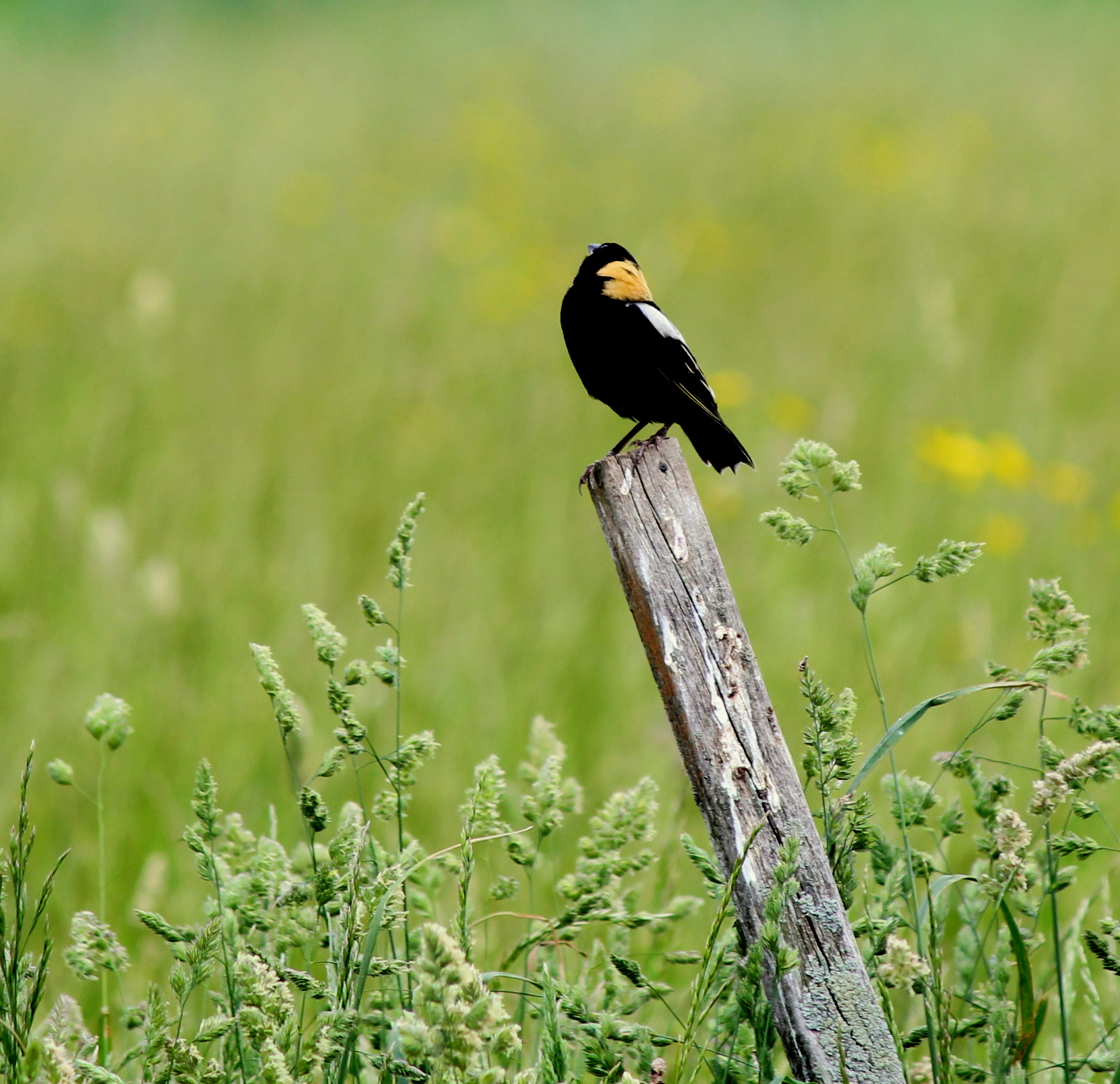


The part we can recognize by ear is the shared collection of song patterns characteristic of the South Russell and Frohring Meadows Bobolinks. Here's my 2013 recording of these song components:


So now to 2019. Have the songs been consistently transmitted to the next generation? Is the same Bobolink population returning to these meadows year after year? As someone who teaches ear training professionally, I want to know what I’m hearing and ponder what it might mean.

I heard three consistent song patterns over and over again across the entire meadow. All the males sang them. Sound familiar?


My next stop was the large meadow along Sperry Road at the Holden Arboretum in the Kirtland area of Lake County. I knew the song of this Bobolink meadow well, too. I had given Music in the Meadow bird song classes for Holden on two or three occasions in the past, and the indoor class was followed by an outdoor listening walk through this meadow. This is what the Bobolinks were singing back in 2011...


...and these were the recognizable song components in 2011, 2012, and 2013:


The last time I taught the class, I had the participants sing the primary Holden Bobolink theme in the classroom and then again at the edge of the meadow. And when they heard the first Bobolinks, they recognized those birds’ special song! They were so pleased! 


On my June 2019 visit, I didn’t hear long flight songs because it was later in the day and the males were singing from perches. Human noise was present as well. But the song patterns could not have been more clear:


The third Bobolink visit I made this June was to Bath Nature Preserve in western Summit County not far from the Medina County line. This preserve's Bobolink songs - particularly the clear, three-note motive -  had been recognizably different from the South Russell and the Holden Bobolinks, who were themselves clearly different from each other. Would that still be true here?


These were the song patterns I’d recorded five years ago. In fact, I'd recorded 10 different males all singing the same song. 


At first, the Bobolinks were were far from the trail and I didn't want to jeopardize their nesting success by going off the trail. But I recognized what I was hearing, and eventually, two males were singing close enough to record. 


Once again, the songs were the same as five years earlier!


These populations seem stable. I can count on finding Bobolinks here, and there are additional locations in our region where this is true as well.


But there are other places where habitat loss, extreme weather events, and early mowing while young Bobolinks are still in the nest have impacted these birds. The songs I recorded several years ago may no longer resonate in these meadows. I had hoped to get better recordings of two of my favorite songs, but I haven’t been able to bring myself to return to those locations to see if Bobolinks are still present. Habitat tragedies occurred on consecutive years at both of these sites, and the numbers were already rather small. Maybe I’ll go to these places next May...maybe…

I'll close with a June 2019 Bath Nature Preserve Bobolink flight song. 


Field observations are valuable - especially over time. Fascinating stories reveal themselves as we keep listening.


Tuesday, July 15, 2014

Bobolink Concert Postlude and Program Notes


I have two final two locations to present in my ever-growing Bobolink song collection.  The first is Carlisle Reservation’s Equestrian Center in the Lorain County Metro Parks near LaGrange, which is west/southwest of Cleveland.  The second is Byers Woods in the Ashland Park District just outside of Ashland, which is far to the southwest of the Cleveland area and close to Mansfield.  As I’ve done with the other Bobolinks, I’ve separated out what I found to be short, recognizable song components followed by longer, more complex songs that include those components.  I know this has been quite a few songs to try to remember.  There’s no quiz on the material.  I’m sure I’ll have to review them all myself next year.

I visited the Carlisle Equestrian Center after reading on the OhioBirds list serve that Bobolinks had returned there.  I’d been to Carlisle Reservation, but wasn’t familiar with the Equestrian Center area or aware that Bobolinks nest there.   The day I went to investigate, a draft horse plow-pulling competition was in progress.  Pick-ups and horse trailers were numerous, but they were across the driveway from where the Bobolinks and Meadowlarks appeared to be in residence. 

Here are the song components that seemed to be consistent with the exception of a single Bobolink singing from a tree next to the parking lot.


Byers Woods is a beautiful Ashland County park that includes a closed landfill.  The landfill is now a very large grassland with many Bobolinks and Meadowlarks present, and the park itself enables people to walk along paths in the area.  Mowing is delayed until after the Bobolinks have fledged, and the Greater Mohican Audubon Society holds a Bobolink and Butterfly Festival there on a Saturday in June each year.  It’s a wonderful place for grassland birds!


The songs were a little harder for me to recognize, but here are the patterns I was able to determine. The short patterns are followed by some of the songs.


Just last week, I saw male Bobolinks that were beginning to molt out of their festive black, white and yellow and into their brown and gold non-breeding plumage.  Their season of song has ended, and soon they will look similar to the females.   It’s an appropriate time for my Bobolink song summary.


Here’s a photo of a map of all the sites where I made Bobolink recordings.  I’ll include a link to the Google Map below the picture, and you can use this link to see the names and counties of each of the points on the map.   I think you’ll find this helpful as I describe the song relationships I found (or did not find).

You can access this map and look up the name for each location here.

One of the puzzling, yet interesting things I’ve been trying to learn from these songs is which pitches are actually a part of the songs.  These birds are not soloists on a quiet stage.  There are other birds singing and almost constant human noises of various kinds.  I had to edit out as much human noise as possible to get to what the birds were singing, and then attempt to separate out the pitches in individual birds’ songs. 

It was tricky at times simply because the pitches that I as a human musician could identify most readily were those that often fit astonishingly well into the tonal organization typical of western music.  When I heard (and saw on the sonograms) pitches that seemed out of place or dissonant, I would have to try to determine if they were part of the song, pitches from other nearby birds, or random pitches left behind after editing.  I looked at/listened to how consistently these pitches seemed to occur in relation to other pitches within the song.  If there appeared to be some consistency, I left those pitches alone even if they seemed somewhat dissonant to my ears.  I’m not a Bobolink, and I don’t know their scores.  I’m doing my best to report what I hear.

Now that I’ve edited and reported what I heard at the twelve Bobolink locations I've visited, here’s what seems the same, somewhat related, or unrelated.

The Bobolinks at South Russell Village Park and at Frohring Meadows sing the same songs, but these parks are adjoining properties.   The two male Bobolinks at Swine Creek and South Russell/Frohring in Geauga County and those at Metzger Park in Stark County sing songs that share one of the basic song pattern but not the unusual triplet pattern. 

The Bobolinks at CWRU’s Squire Valleevue Farm have a melodic pattern with similar pitches in a different order.   Interestingly, last year I heard one Bobolink sing the Squire Valleevue song at Frohring Meadows.  This year, I heard one Bobolink consistently singing the Frohring Meadows/South Russell song at Squire Valleevue Farm.  I have never heard any Bobolink sing any other song than the expected Squire Valleevue pattern at the Farm, and I’ve been listening to those Bobolinks longer than any others.  These properties aren’t all that far apart, however –just under six miles.  To me, it’s more surprising that the songs at Squire Valleevue Farm are recognizably different!

The Bobolink songs from the Bath Nature Preserve in western Summit County were the same as those I was able to record at the former Richfield Coliseum site in the Cuyahoga Valley National Park.  I won’t know if all the Richfield Bobolinks sing the same song until I have a chance to explore the entire area, but those  I did hear seemed consistent.  The Bobolinks at Wolf Creek had a song that was somewhat different, but still related to those at Bath and Richfield.  Allardale Park, however, surprised me because the songs there seemed considerably different in spite of its proximity to the other three sites.

This next paragraph is primarily for the musicians reading this post.  Although some Bobolink songs did not seem to share a significant pitch pattern similarity to any of the others I heard, a number of them had an opeining figure that was approximately a perfect 4th or a perfect octave leap.  Here’s a collection in the following order: Holden, South Russell/Frohring meadows (octave), Carlisle, Bath, Richfield CVNP, Wolf Creek (P4th) and Byers Woods (more or less a P4th).   These intro patterns contribute to the tonal quality of the songs.


The Holden Arboretum Bobolinks remain quite unique in their melodic song pattern, sharing only the pattern I described above.  Even then, theirs is a perfect octave, not the more common perfect 4th.  All of the Holden Bobolinks I’ve heard there in the past 4 years sing the same song, and it really is noticeably different from any other songs I’ve recorded in the region to date. 

I had hoped to find something similar to Holden at a closed landfill that has been restored as a large grassland area in Lake County.  It’s only about 5 miles southwest of Holden.  The public does not have access to this landfill as would be possible at Byers Woods, but I was hopeful that I’d hear the Bobolinks on a special field trip through the Geauga Park District.  Alas, the afternoon was chilly and rain set in almost as soon as the field trip began.  I saw that Bobolinks were present, but they were not singing in the rain and I would not have been able to record them even if they had done so.  Maybe next year…

I'll miss hearing the Bobolinks, but they have a round trip to make to Argentina and back before I hear them sing again.  I’ll leave you with a track that includes the characteristic pitch patterns of each location’s Bobolink songs.  (The songs are in alphabetic order by location, and the entire track is about a minute and 45 seconds.  The arrow is right above the photo below.)

Crickets and katydids are beginning to sing now, so it’s just about time for me to turn my attention to the insect percussion ensemble and the magical concerts of the night.


Wednesday, July 9, 2014

Bobolink Songs, part 2: NE Geauga and Stark Counties


The Bobolink road trip is heading east today.  One of the reasons I became so intrigued by Bobolink songs at specific sites was because the Bobolinks at Holden Arboretum in Lake County have song components that are completely different from those in southwestern Geauga County.  What’s going on with the songs in the eastern parts of NE Ohio?


There are scattered Bobolinks in Geauga County, so I set out to find ones I hadn’t yet heard.  I made two trips to Observatory Park in far NE Geauga County and found a few Bobolinks singing in a meadow near the observatory itself.  I later came across two singing males in the northwestern part of this large park.  Their songs were the same at both parcels, and these songs were different from others I’ve heard to date.


Here’s what I heard when the males were doing what I call their “fancy flight” – a slow, fluttering flight display accompanied by a long and extremely complex song.  Savannah Sparrows were singing from their perches as the Bobolinks circled above the meadow.


As you know by now, the next step is to try to extract the recognizable song components from their songs, as these are what will make each Bobolink group identifiable by ear.  Recognizing song components in the flight song is very difficult, but those recurring pitches are much more accessible in the Bobolinks’ shorter songs.  I’ll include a sonogram for the first part of the recording so you can see what you’re hearing.


What next?  Time to head 9 miles south to Swine CreekReservation, a beautiful Geauga Park District property outside of Middlefield in Amish country.  Swine Creek has stunning woodlands, a gorgeous stream, and a characteristically NE Ohio goldenrod meadow.  It's not the grassland meadow that Bobolinks generally prefer, but I'd read on eBird that Bobolinks had been reported there. Sure enough – there were two singing males and at least one female.


I had expected recording them to be easier than many places because the sound of horses and buggies is just not that obtrusive.  The unexpected challenge for me was a long-idle old gas well that had suddenly come back to life.  There it was, squeaking and rumbling away in annoyingly close proximity to the Bobolinks.  It wasn’t going to stop, either, so I’d just have to do what I could with whatever I could get.


I’m glad I didn’t give up and leave, because there was something interesting here.  I heard a song component that sounded very close to the three-note pattern from Frohring Meadows and South Russell Village Park 18 miles to the west/southwest.  The bouncy triplet pattern wasn’t present and the notes were more separated (or "choppy"), but the pitches jumped out at me.  Here’s the song pattern followed by a complex song.


Next is a recording of three statements of that song pattern.  Sometimes the first two pitches are repeated and it’s as many as six notes, while other times it's just three.  These pitches are not as smoothly-connected as the South Russell song, but I'm sure you'll hear the similarity.   I’ve made the comparison easier by adding three statements of the South Russell song pattern at the end of this recording.  


Were these Bobolinks previously part of a larger group?  What about the small number of Bobolinks at each of the Observatory Park areas – did they split off from a larger group as well?  When there are just a few Bobolinks at a certain location, where did they come from? I certainly wish I knew.


Our final stop for today is Metzger Park, and it’s a bit of a drive.  Metzger Park is 44 miles south/southwest of Swine Creek Reservation in Louisville, which is east of Canton in Stark County.  (That’s Louis-ville, as in Louis with an “s”, by the way.)   This city-owned park now delays mowing its large, grassy meadows until after the Bobolinks have fledged and are ready to leave for South America.   

I began hearing Bobolinks as soon as I approached the trails that run through their extensive meadowsHere they are with the ever-present Red-winged Blackbirds.


Next, here are two basic song patterns.  One is rather odd, and I haven’t heard it anywhere before.  It sounds slower and more deliberate somehow, and that may in part be due to the straight eighth notes where songs at other locations often have combinations of eighth and sixteenth notes or even triplets.  The song patterns in the first half of this recording, though, may remind you of something you just heard.  We'll listen closer in the next recording.  


Now listen to Swine Creek, South Russeell and Metzger back to back.  What do you notice?


They're quite similar, aren't they? But Metzger Park is a significant distance from Swine Creek and South Russell, while places that are much closer have Bobolinks singing very different songs.  I really want to know why!

I’ll leave you with one more recording from Metzger Park while you look at the map.  (Observatory is the northernmost of the three parks.)  I like the Metzger Bobolink songs a lot.  OK, I like all of them a lot, and I’m very much enjoying hearing and learning so many different songs!


My final post in the Bobolink series will add songs from Lorain and Ashland Counties.  I'll summarize with a comparison of what’s similar and whose songs seem unrelated to anything I've heard to date.  I'll also include a map of all the places where I’ve recorded Bobolinks in the past few years.  Who knows what I'll learn next year?


Wednesday, July 2, 2014

Bobolink Road Trip 2014: Summit and Medina Counties


The Bobolink Road Trip has begun!  The first installment of my Bobolink song comparison will explore the songs at four locations in Summit and Medina Counties.  This is south of Cleveland and closer to Akron, and all four of the places I visited are within 12 miles of each other.  There's a map at the end of this post.

Today’s story begins at the Bath Nature Preserve in Western Summit County not far from the Medina County line.  I’ll then head southwest to Wolf Creek Environmental Learning Center in Medina County, back north to Allardale, and finally to the northernmost point in this collection: the former Richfield Coliseum site that is now a huge grassland in the Cuyahoga Valley National Park.
One would think that at four locations relatively close to each other, the Bobolinks would sing the same – or at least similar – songs.  Not necessarily!

I’ll start with Bath Nature Preserve, partly because I can’t get their Bobolink song out of my head.  Here’s how I’ll approach each song – and why.

The question I’m exploring is whether I can continue to identify Bobolinks by location based on their songs, and if so, what am I listening to that enables me to do this?  There seem to be little melodic motives that are common among the Bobolinks at each location I visit, and those are clear enough that I can hear and recognize them as I would human music.  Here’s how my process works:

As soon as I walked from the parking lot to the edge of the meadow, this is what I heard:


These are the musical elements that caught my attention and weren’t too fast and complex for my ears to follow.  I’ll break this down into the smallest segments, then add them back together.


Now I’ll take what you just heard and saw, and add a little more…


…and now I’ll go all the way from the most simple to the complex Bobolink song which includes these small musical elements.  I think it will be easier for you to pick them out of the texture now.


Are you starting to get the idea? You can actually sing some of these little melodic motives, and those would be the parts that we could identify by ear as the Bath Nature Preserve Bobolink song.
The three males close to where I was standing were still challenging each other and sometimes flying right over my head.  All three sang the same song, as they did when I visited then subsequently.

The next stop is across the Summit/Medina county line. I’d heard that there are Bobolinks at the Medina County Park District’s Wolf Creek Environmental Learning Center, which is only 6 miles SW of Bath.  This was a new place for me, and one I’ll certainly want to explore in the future.   Interpretive Services manager Shelley Tender gave me great directions for finding the Bobolinks on the property.  There were only a few singing males, but it was enough to get some recordings.  All were singing the same song, and it was not the song I heard at the Bath Nature Preserve.


Could you hear a difference?  There are some similarities, but this particular motive was definitely a new one to me.  Take a look, then listen to the track again:


She also said that Allardale  (also in the Medina County Park District) would be a very good place for Bobolinks.  It’s not far from Wolf Creek and is actually only 2+1/2 miles from Bath Nature Preserve, so that became my next stop.  Surely their songs should be related -  or so I thought.

I found a number of Bobolinks singing along both sides of the bridal trail, and I immediately thought their songs were different from ones I had heard elsewhere.  But what was different about them?


The recording you just heard had two singing Bobolinks – one closer and one a little farther away.  Here are the musical elements that make the Allardale songs unique for me:


Here is one more Allardale recording so you can hear the musical motives in context.


The last site in this collection used to be the Richfield Coliseum.  It was all about basketball and concerts from 1974-1994, but the structure was torn down in 1999. The land subsequently was taken over by the Cuyahoga Valley National Park, and now there’s a huge Bobolink meadow in its place.  There’s no sign other than the Important Bird Area designation, and there are no trails or anything approaching a welcoming parking area. 


This place is clearly for the birds, not the humans, and I think that’s quite appropriate.  There are no trails, though, and I certainly didn’t want to disrupt anyone’s nesting.  I walked carefully around part of the perimeter and stayed out of the meadow itself.   It’s on a main road (Rte 303) at the I-271 freeway exit, so there was plenty of noise in addition to wind.   I did get some recordings, but as is often the case anywhere that humans are present, considerable editing was necessary for you to be able to hear the avian music above what humans were contributing to the sound texture.

So this is a quiz: listen to this recording from Richfield and consider if anything sounds recognizable to you.


I'd heard this song before, and now, so have you.  Of the three Bobolinks I recorded there, two were singing the song I’d heard at the Bath Nature Preserve!  


A third Bobolink high above the meadow was singing a different – through not entirely unrelated  - song.  It was what I call the "fancy flight" song in which the male does a beautiful, slow, fluttering flight display while singing a song so long and complex that it seems almost impossible that one bird can sing all those notes.  These "fancy flight" songs may contain the characteristic song motives at the beginning, but will quickly depart from anything I can recognize or remember.

Richfield has a lot of Bobolinks, and it would be interested to determine if other songs are being sung in this meadow.   Next year, I’ll want to record there as soon as the males return, and I’ll walk the entire perimeter before any Bobolinks are nesting.

Here's a map showing all four locations.  Richfield is at the top right of the map, Wolf Creek is the farthest southwest, and they're all relatively close to each other.


That was a LOT of information, and I think a rest stop is in order.  The next part of the journey will take us to eastern Geauga County, then all the way south to Stark County.