
While reading through this blog post text draft, the night of October 31st eased into November 1st. The first lake effect snow of the season quietly transformed everything outside my windows into white and brown, while the crickets and katydids in the dining room continued to sing as if it were still September.
My survey work is primarily by ear, as it’s often done at night and these small, well-hidden insects are not necessarily easy to spot. During the singing insect season (generally July – September in NE Ohio) there are specific crickets and katydids that mature and sing at the same time. I know these species individually, but I also know them as ensembles.
I listen as a professional musician, so I’m very aware of pitches, rhythms, and also which insects sing at the same time in various habitats and at different times of the summer and early fall. I expect to hear certain species together, which is why I refer to them as ensembles.
For example, in my recent “Unsettled Summer” blog post, I wrote about three of the early species of katydids that mature beginning at the end of June and continue to be center stage through the first three weeks of July. These were the Gladiator Meadow Katydid (Orchelimum gladiator),

and the Broad-winged Bush Katydid (Scudderia pistillata).
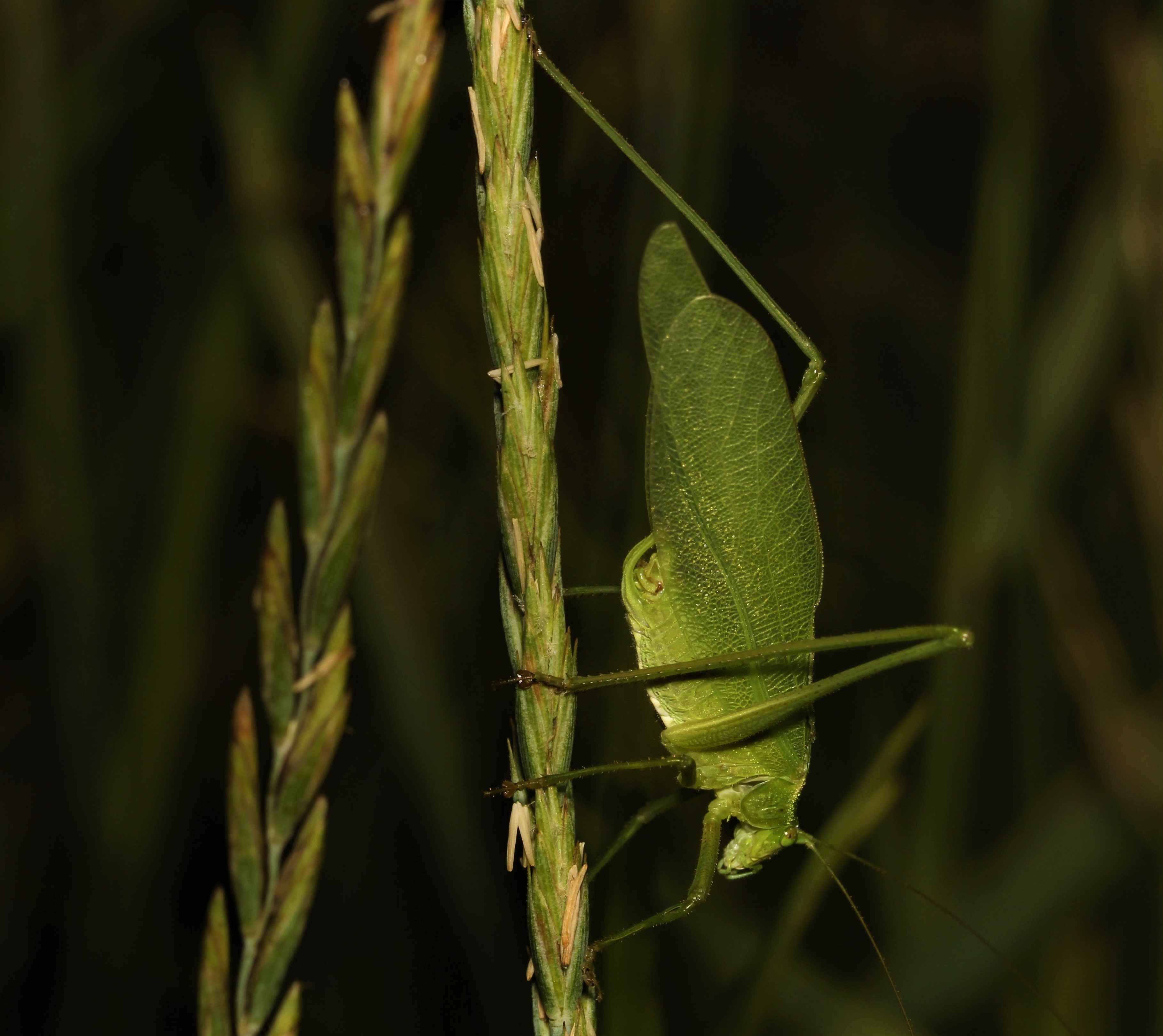
Here are the two species together - a gentle, peaceful duet.
A few weeks later, the Sword-bearing Conehead (Neoconocephalus ensiger) will join them.

Tree Crickets would not yet be singing, nor would the other katydids. Therefore, the Gladiators and Broad-wingeds are an opening duet that is subsequently joined by the Sword-bearers.
These three katydids are near the southern edge of
their ranges, as you can see from these range maps from Singing Insects of North America.


Gladiator Meadow Katydid, Broad-winged Bush Katydid, and Sword-bearing Conehead range maps
Is this why they sing earlier
than other species? I've also observed that the crickets and katydids who are moving up from
further south are ones who begin singing later in the summer such as the Round-tipped Conehead.

Around the third or fourth week of July, the Curve-tailed Bush Katydids typically join the early katydid trio. Their rhythmic pattern contrasts with the Broad-winged Bush Katydids and adds another instrument to the percussion ensemble. This is as expected.

Shortly thereafter, the Oblong-winged Katydid and Rattler Round-winged Katydid will also begin calling. The insect ensemble initially consists primarily of katydids and ground crickets, with the first tree crickets only beginning to sing in late July.
Therefore, the July ensembles will primarily feature the
percussionists, as I call them. Why that description? The songs of katydids are
higher and more complex than what we’d perceive as pitched instruments, typically ranging from 8
or 9 kHz to at least 20 kHz. This is where we might hear consonants rather than
vowels in human speech and where many non-pitched percussion instruments would be
heard in an ensemble. (These are also the frequencies that our ears may
gradually lose with age, which is why hearing tests focus on our ability
to hear consonants.)
So what happens if the July musicians are all late in maturing, as they were this summer? They might begin singing in their usual ensembles, but the concert would start later than expected. Sonic relationships are maintained, but the performance time is delayed. Earlier ensembles may subsequently overlap with ones that typically sing later.
But what if a single species is either late, occurs only in small numbers, or doesn’t appear at all? This results in a sonic gap because part of the ensemble is missing. This, too, was apparent, especially in July and early August.

I noticed missing part in the July ensemble this summer; there were far fewer Curve-tailed Bush Katydids than I’d expected. During the past few summers, I had begun to wonder if their numbers were decreasing but couldn’t exactly document the change. What I heard this year was obvious, and it worried me. It was unsettling to have one of the ensemble members in lower-than-expected numbers. It was a gap in the music.
The Common True Katydids should have made their noisy presence known toward the end of July…but no one seemed to cover that part in the orchestral score. They’re impossible to miss when they’re present, as they are loud and insistent.

Common True Katydid (Pterophylla camellifolia) chewing on my hand.
Their absence was apparent.
Why weren’t they calling from up in the trees? I couldn’t even imagine our backyard and those of our neighbors without this important member of the Orthopteran orchestra! I worried about what might have happened to them. Was it the violent storms of early August? Numerous tornados formed across northern Ohio in just one night, and a substantial amount of tree damage occurred.
I began to hear them in some places a week or two later, but there were none singing in the immediate vicinity of our yard. They didn’t begin to call until later in August – about 4 weeks late!
What were the factors?
As you may recall from my other posts, there is a significant ensemble change at the end of July. The Gladiator Meadow Katydids begin to fade out and are replaced by their Black-legged Meadow Katydid cousins.
 Black-legged Meadow Katydid (Orchelimum nigripes)
I begin to hear fewer Broad-winged Bush Katydids (Scudderia pistillata) and many more Curved-tailed Bush Katydids (Scudderia curvicauda) taking their place. That’s the way the score reads, anyway…
But recently, there seems to be a decline in Curve-tailed Bush Katydid numbers, and I saw or heard far fewer than I would have expected. Eventually, I began to hear another of their Scudderia cousins that matures a little later– the Texas Bush Katydid (Scudderia texensis). Yet their numbers also seemed quite low, as they have in the past few years.

Texas Bush Katydid (Scudderia texensis)
Where were the Scudderia? Was something happening to
the most prominent members of this genus? How should I document my aural observations?
I didn’t expect to see or hear many Oblong-winged Katydids because they were quite abundant last year. It seems that a year of abundance is typically followed by a year of scarcity, so I wasn’t overly concerned.

Their little cousins, the Rattler Round-winged Katydids, are not very common in my area – at least not now. I did see and hear more of them several years ago, but now I’m surprised and pleased when I encounter them.

Rattler Round-winged Katydid (Amblycorypha rotundifolia)
Recording of the Rattler Round-winged Katydid followed by the Oblong-winged Katydid
Meadow katydids did not seem to be as impacted, nor did the Greater Angle-wings up in the trees.

It was the bush katydids' unexpectedly low numbers that were troubling to me.
Fortunately, most of the tree crickets filled the meadows and woodland edges with their August and September choruses, though they, too, were later than expected.

Ground Crickets, Fall Field Crickets, and Jumping Bush Crickets were not a concern, nor were the Handsome Trigs and Say’s Trigs.
Once they all matured, the missing songs were less apparent and the choruses sounded reassuringly complete. 

Says Trig (Anaxypha exigua)
I realized I was beginning to create two categories of observations:
1. All
the katydid and cricket species in my region seemed to mature later than usual, and some very much so. I’ve talked with a number of naturalists who are knowledgeable about other insects and who noticed similar delays. I also heard reports of various plants being late as well. I know when to expect to hear my region's singing insects, but now I may need to think through some more specific documentation.
What factors may have caused this delay
across species? As I noted in “Unsettled Summer," NE Ohio
had three consecutive weeks in May with no rain. This never happens in the greater Cleveland
region. September was also very dry, yet July had considerably more rainfall. Violent storms, including numerous tornados, occurred even in the greater
Cleveland area on two consecutive days in August. A significant amount of storm
damage resulted - especially to trees - even within Cleveland's city limits.
2. The absence of some of the expected singers within seasonal and habitat ensembles was more disturbing to me, as I worry that we could be seeing/hearing the first signs of losing particular species. As a human listener, it’s not only one species that’s unexpectedly missing. That absence affects the overall sound and general sense of environmental well-being I experience when a group of katydid and cricket species sings together in their seasonal ensembles.
I have been listening to climate change in NE Ohio for years. This has meant hearing new songs (both Orthopteran and avian) from farther south in Ohio that gradually join those of the expected residents up here in NE Ohio.
What I was hearing this year, however, was different. It was about absences.

I've included quite a few recordings in this post so you can match up the photos with the sounds. I’ll write more next summer about insect songs and
ensembles. In the meantime, you can look up all these crickets and katydids in my
online field guide, Listening to Insects at Listeningtoinsects.com.


