What a warm winter this has been! There's been very little snow, Lake Erie didn’t freeze, and last week was a series of days in the 50s, 60s, and even 70s! Actually, quite a few days have been above normal and a surprising number of nights have not dipped below freezing. NE Ohio residents, how often have you heard people say, “I love it, but it’s not right…” or even, “This isn’t the Ohio I know…”
How does this February sound? What seems right, and what doesn’t?
I've heard Cleveland-area people commenting on how many birds are singing already, but is that abnormal? Actually - no. I expect to hear bird song in the back yard by February 2nd, which is the halfway point between the Winter Solstice and Spring Equinox.
I've heard Cleveland-area people commenting on how many birds are singing already, but is that abnormal? Actually - no. I expect to hear bird song in the back yard by February 2nd, which is the halfway point between the Winter Solstice and Spring Equinox.
 |
The House Finches typically begin singing in late January, closely followed by Northern Cardinals, Mourning Doves, Black-capped Chickadees, White-breasted Nuthatches, and then Tufted Titmice. Woodpeckers start drumming. The Grackles return around the third week of February making all those raucous, territorial squawks as soon as they arrive. Red-winged Blackbirds return with comparable noise about the same time in somewhat more rural areas.

What I don’t expect to hear are American Robins singing. Robins can be found here in the winter, traveling in flocks to dine on the berries of ornamental trees. But they don’t establish their preferred singing perches for a while yet – certainly not until sometime in March or early April. This year, they’ve already been caroling in our neighborhood for the past week.

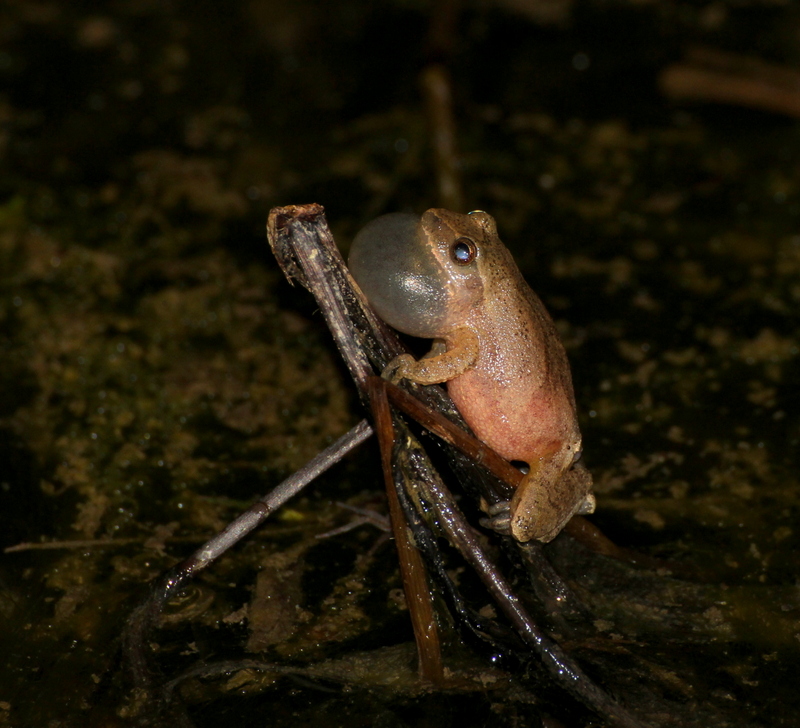
What’s even less expected is amphibian song. Spring Peepers. Wood Frogs, Western Chorus Frogs. Mid or late March, yes, or maybe early April. But late February? I have never heard them so early up here!

What’s even less expected is amphibian song. Spring Peepers. Wood Frogs, Western Chorus Frogs. Mid or late March, yes, or maybe early April. But late February? I have never heard them so early up here!
After reading numerous reports of frogs singing, I went to look and listen for myself. With temperatures in the mid-70s predicted for February 24th, I decided to begin my search at Bath Nature Preserve in western Summit County. I’d heard occasional Spring Peepers and Western Chorus Frogs there this past November and even in January.
I’m going to retrace my route so you can share my late afternoon and evening investigation.
It begins in western Summit County at Bath Nature Preserve, not too far from the front parking area. It was 76 degrees with a south wind. In the distance, the traffic on I-77 was audible, even though the preserve is not on the freeway.
Listen:
A Tufted Titmouse was singing insistently. Titmice typically sing insistently (and incessantly).


A Song Sparrow – now that’s a bird I generally expect to hear sing later in March, even though some overwinter up here.


A Red-winged Blackbird proclaimed from up in a tree overlooking a wet area below him.


Another Song Sparrow…
Then a loudly-chattering Red-winged Blackbird swooped past me and landed in a group of House Finches.


I walked a little farther, and the Titmouse’s song seemed to be picked up by a few Spring Peepers.

Yes - they really were singing! Then the small Peeper chorus became backup singers to…
…a Western Chorus Frog! One of my favorites! They're so very tiny and well, hidden, though, that I very seldom actually see one.


There were more Western Chorus Frogs just a little farther into the sedges and grasses, and I listened to the gently rhythmic, peaceful ensemble while feeling my pulse slowing and my breathing relax.
February 24th. It was beautiful…but it wasn’t right.
And what about those other very tiny frogs - the Spring Peepers? I’d heard several individuals scattered throughout the Western Chorus Frogs’ concert hall, but would there be a large, noisy Peeper chorus?

As I walked back to the parking area, I heard them off in a relatively inaccessible area that seemed to be near the property boundary. Could I get close enough for a representative recording?
Well, there were a couple of problems.
I decided I’d better try somewhere else.
I drove 35 miles north/northeast to Peeper Paradise: Cleveland Metroparks’ North Chagrin Reservation on the Cuyahoga/Lake County border in the snow belt. My specific destination was the wetland off Wilson Mills Road near Chagrin River Road. The sun had recently set, which was perfect. Frog song typically increases with diminishing light.

I wasn’t sure I heard them at first because of Wilson Mills Road’s incessant automotive procession. But as I walked toward the wetland, their calls emerged from the traffic texture:
It sounded glorious – like a warm evening in late March or early April! And did you hear a few Wood Frogs in the mix along with the occasional comments from a Canada Goose?
Cleveland and Akron broke their high temperature records for the day, for the month, and tied their records for warmest winter temperature ever recorded. A cold front came through that night, but temperatures have returned to around 60 for the last day of February and first day of March.
I’ll be honest with you. I don’t enjoy winter. I love this weather. But I worry about the salamanders, the frogs, the insects, the plants…
…because although it sounds so splendid, it isn’t right.