Showing posts with label Round-tipped Conehead. Show all posts

Friday, January 3, 2025

Field Station Exploration

                           Field Station Exploration


  Hiram College field station, Portage County, NE Ohio


The ground is snow-covered now and there's a Lake Effect Snow Warning here in NE Ohio. My last surviving Broad-winged Tree Cricket finally passed away in December but my ancient Black-legged Meadow Katydid is still singing occasionally in his spacious mesh butterfly cage in the dining room. (If you read my preceding post, "The Prodigal Katydid," this katydid was the featured character in the story.) He no longer climbs up high in his cage, but he has a very nice array of foods arranged along its floor.


     Black-legged Meadow Katydid on 1-3-25.  On the left is his grape half, on the right are                hydration cubes, and seeds from his bulrush seed heads are on the floor of his cage.
                         

Although we have the inevitable traveling crowd of House Sparrows here at the moment, I’m focusing on all the other birds in our natural backyard and at our feeders. Still, I deeply miss my summer and early autumn afternoons and nights in the meadows, marsh edges, and shrubby woodland borders that are over half a year away.


Summer feels so distant now.


During that past 15 years that I've studied singing insects throughout NE Ohio, I’ve spent more time in Geauga County than anywhere else in NE Ohio and have also done surveys in Lake, Summit, Stark, Lorain, Medina, and Cuyahoga Counties. 

                                  Northeast Ohio - Wikitravel     

                                                           (Wikitravel.org)

I had visited three of the Portage County parks a number of years ago, but hadn't spent as much time in that county as I thought would be helpful to regionally connect Geauga to Portage to Summit.

But where would I be able to spend considerable time in this rural county?

Perhaps the 550-acre Hiram College Field Station in Portage County might be interested in my survey work. I didn’t know anyone there except their Education and Outreach Director, Mike Sustin, whom I’d previously met at other regional park districts. He cheerfully became my Hiram Field Station contact person. Field Station director Dr. Michael Benedict and the staff also welcomed me.

I couldn’t possibly explore the entire property in one summer and needed to target the areas that seemed most likely to have substantial numbers and diversity of singing insects. I also needed to consider what felt safe to explore during my typical nighttime forays.

There were shrubby meadows, woodlands and a large prairie within walking distance of where I parked my car. I would need to keep the trail options organized in my head, as it would be easy to become confused in the dark. 


Fortunately, Wendy (my wife) accompanied me first by day, then on my initial night exploration as I learned the trails. I found some landmarks – the occasional signs, the hanging grapevine dangling above the trail, an opening in the tree canopy…

As you probably know by now, I am drawn to meadows and prairies. They are the most productive places to search for crickets and katydids, and I cherish the openness and all that sky above me – especially at night.

Park district land managers are turning former farm fields into meadows and even prairies of native grasses.  Mike Sustin introduced me to Hils Vista, which is the prairie-in-progress at the Hiram Field Station. (It is named after professor of biology and former Field station director Matthew Hils. You can read more about the field station's Grassland Program here.)


The prairie was filled with big bluestem and other prairie grasses instead of the usual dense goldenrod meadows I love and know so well. It was gorgeous! 

Who might I find there?


As I walked farther down the long hill, meadow vegetation like goldenrod, ironweed, and Joe-pye weed began to dominate closer the bottom of the trail near Silver Creek.  Could I have both prairie grasses up higher on the hill and meadow vegetation farther down – and perhaps changes in the Orthopteran species along the extensive trail? Excellent!


July in NE Ohio is the time to look and listen for early katydids, with the first tree crickets joining them as the month progresses. The prairie grasses were perfect for the first Sword-bearing Coneheads in July.


                                 Sword-bearing Coneheads at the Hiram Field Station


I have been concerned in recent years about lower numbers than expected of Broad-winged Bush Katydids and even our previously abundant Curve-tailed Bush Katydids. Would I find them out here?  

Yes! The Broad-winged Bush Katydids were right on time, followed shortly thereafter by the Curve-tailed Bush Katydids. The  numbers weren't  high, but I was very glad - and relieved - that they were present.


                                Broad-winged Bush Katydid male, Hils Vista 

          Curve-tailed Bush Katydid in the prairie grasses - not where I typically see them


NE Ohio’s widespread look-alike/sound-alike Black-horned Tree Crickets and Forbes’s Tree Crickets prefer goldenrod, but this was a large meadow filled with native prairie grasses. I'd look for them elsewhere on the property.


However, I often find Four-spotted Tree Crickets in tall grasses, and Hils Vista was apparently a very attractive habitat for them.  


By the third week of July, I heard their songs scattered along the trails and saw them mating.


          Four-spotted Tree Crickets mating (above) and a recently-mated female, Hils Vista.


Broad-winged Tree Crickets mature a little later, and they, too, were in the prairie grasses and forbs. This is not where I usually find them in my region; blackberry and goldenrod are where I expect to hear Broad-winged Tree Crickets, and they are typically very well hidden in the dense vegetation. 


                                                Broad-winged Tree Cricket singing                                  


The songs of the Broad-winged Tree Crickets were mixed with those of the Four-spotted Tree Crickets, and the pairing of these two distinct songs caught my attention. It sounded familiar, but not from the dense goldenrod/blackberry meadows and thickets of Geauga and Lake Counties where Broad-winged Tree Crickets are likely to be singing with Black-horned Tree Crickets in  areas with shrubs or Forbes's Tree Crickets in the goldenrod.

Instead, the Broad-winged Tree Crickets and Four-spotted Tree Crickets had been singing together in a former agricultural field in Stark County and also in fields and edges in southern Ohio. Here, they were singing together in a Portage County prairie. Sometimes, songs define places for me rather than the other way around.

There were singers on the ground level as well.

Although easy to overlook, Fall Field Crickets and our three most common ground cricket species (Allard’s, Striped, and Carolina) were present almost everywhere. 


       Fall Field Cricket female. The males are the singers and the females lay the eggs.   


Tiny Spring Trigs in the meadow vegetation were followed by Say's Trigs and Handsome Trigs in meadows and shrubby edges


 Say's Trig - only about 1/4" in size 
Breakneck Creek Preserve, Portage County 


August brought the penetrating songs of another conehead species: the Round-tipped Conehead. 

                          Round-tipped Coneheads, Hils Vista, Hiram field station


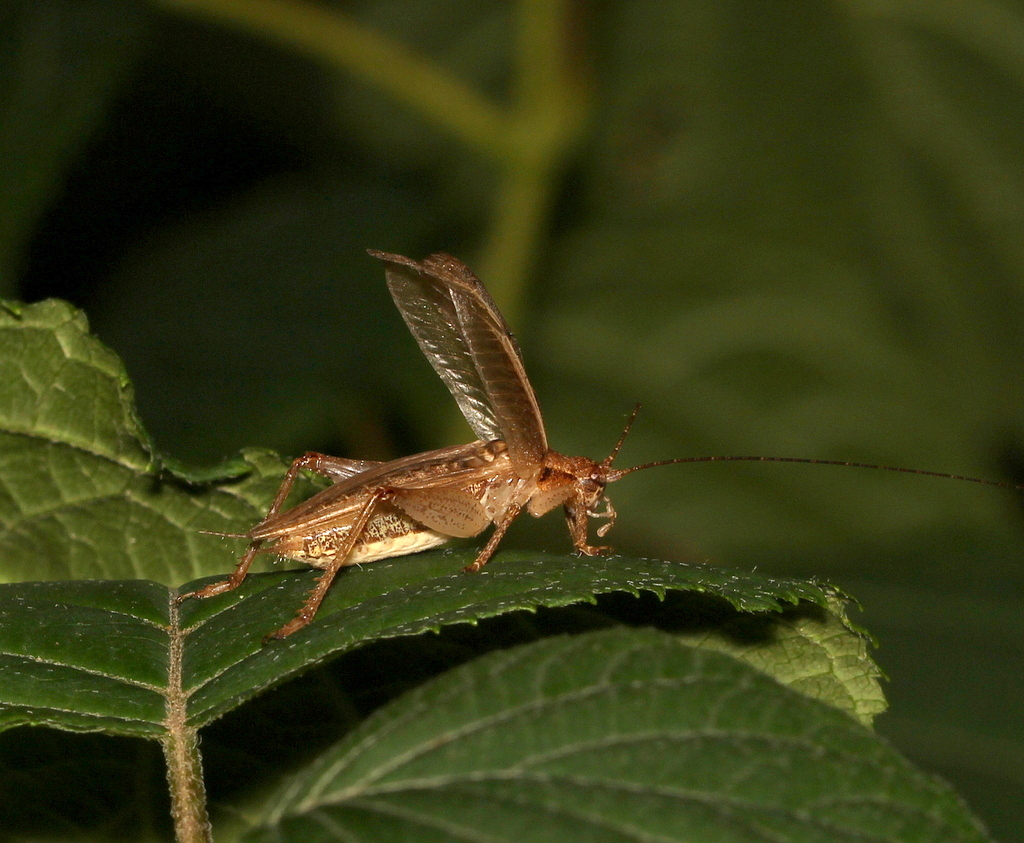
          Round-tipped Coneheads can be green or brown. 

         The individual above was one of the brown Round-tipped Coneheads at the field station.


I’ve documented Round-tipped Coneheads as they've moved north into my region from southern Ohio, and they are now are well-established all the way up to Lake Erie.

Round-tipped Coneheads mature in mid or even late August,and mid-August is when I began hearing adult males singing in the prairie grasses of Hils Vista.


But there are still more areas I haven’t even visited yet. Who knows which species will be singing there?

The Hiram Field Station has been a delightful discovery! I’d like to return there again this summer to see – and hear – if there are any additional species I might have missed or that simply were not present last year. In addition, this past summer was very dry, and I don’t know to what extent this may have affected last year's - and next year's - numbers and diversity.

There’s only one way to find out…


                           Lisa Rainsong · Narrow-winged Tree Cricket and others Hiram Field Station 8-5-24

Sunday, January 19, 2020

Small Delights and Big Discoveries: Field Season, 2019


Gladiator Meadow Katydid singing Mentor Marsh in 2019 after the marsh 
was freed from its phragmites invasion and native plants and insects 
began to return.

Each year in the field brings a few surprises along with interesting documentation of cricket and katydid range expansion. There’s also moments of delight at the small discoveries I’d never see or hear were it not for careful observation as I creep around the meadow vegetation at night. When I step out into the darkness of the singing insect concert halls, I never know in advance everything I’ll hear and see.

The restoration of Mentor Marsh presented an encouraging example of singing insect population recovery with the removal of horribly invasive phragmites. I only heard one Gladiator Meadow Katydid there last year (2018).  This year, visitors on a marsh night walk heard  - and even found - numerous Gladiator Meadow Katydids singing in the native plants on either side of the boardwalk (photo above). 

And look at this lovely couple I discovered at Bath Nature Preserve in western Summit County! 


This female and male Curve-tailed Bush Katydid (Scudderia curvicauda) had just mated, as evidenced by the spermatophore he deposited before they separated. I never see mating katydids, and it’s rare for me to even see the couple together. Bath Nature Preserve provides 404 acres of habitat that supports a healthy diversity of singing insects.


Although I do see molting katydids on occasion each year, I always feel honored when I observe this miracle. The photo below is a bush katydid nymph (genus Scudderia) along Cleveland Metroparks' North Chagrin Lily Lagoon trail along the Chagrin River.


If you’ve read this blog for a while, you know that I study northward range expansion of crickets and katydids, especially as more southern species more into NE Ohio’s “snow belt” counties. 


It's quite apparent why the northeast corner of the state is called the 
"snow belt." It's our gift from Lake Erie and occasionally, Lake Huron.

Documentation and data are more than making lists and obtaining photos and recordings. I’m watching change over time occurring right before my eyes and ears. There’s an engaging element of discovery to it, even when I’m stuck in a blackberry tangle again. 

Here’s some of what I learned this year. Where species names are highlighted, the links will take you to pages in my online field guide where you can hear recordings and see more photos.


Several species are steadily – and rather quickly – moving north to Lake Erie, and I document these changes every year. Additionally, any time spent in the field could possibly bring some unexpected observations. 


I used to go down to Summit County to hear Jumping Bush Crickets, as they weren’t up in the Cleveland area. I was delighted the first time I heard one in our Cleveland Heights neighborhood and thrilled when the first ones arrived in our back yard! 

 Jumping Bush Cricket singing in a hydrangea next to our driveway

Now, however, I search the snow belt for the places they haven’t yet arrived. This year was their Lake County triumph. Instead of being in scattered locations, they seemed to be everywhere I checked. There were still a few locations in Geauga County where I didn’t hear them, but that could certainly change next year. 


Handsome Trigs (Phyllopalpus puchellus) are moving fast as well. They, too, are becoming common in Geauga County and are certainly widely present in Lake County. I seldom even mention Cuyahoga and Lorain counties, where both Handsome Trigs and Jumping Bush Crickets are now abundant.


Round-tipped Coneheads (Neoconocephalus retusus) are also lining up along the lakeshore, as I’ve noted in previous posts. I didn’t hear them in rural NE Geauga County, though, so once again, that may be the area where more southern species are going to take longer to get established. Here’s a Round-tipped Conehead I heard - and eventually located with considerable effort – at Leroy Wetlands in Lake County.


A charming little cricket I’ve been documenting recently is the Spring Trig (Anaxipha vernalis). This southern and central Ohio resident is spreading rapidly in NE Ohio. Their silvery songs are even more lovely than the higher-pitched songs of the Say’s Trigs, and they sing well before most singing insects. Just when I feel I can’t wait any longer for the first cricket and katydid songs, there they are, singing in meadows and edges as soon as evening shadows fall across the vegetation. 

As you'll see in my updated map below I’ve discovered additional locations for them this year. I'm learning that they're increasingly common in NE Geauga County and in Lake County, as are the other northbound crickets and katydids I monitor. 


The non-native Roesel’s Katydid (Roeseliana roeselii is not invasive, and this species actually seems to be less common now than several years ago. I realize that’s an anecdotal observation. Still, I find I'm  somewhat surprised when one of these gorgeous little shieldback katydids shows up in NE Ohio’s fields and meadows

A strikingly colored female caught my attention on a hilltop of a closed Lake County landfill that’s being managed for grassland. The grassy habitat was appropriate, but how did she and her predecessors establish themselves up there? I was determined to catch her to show the participants at a park program in progress, and she ultimately was happy to sit on my arm while being admired. 


Northern Bush Katydids are arboreal insects with high, soft, elaborate songs. Consequently, it’s difficult to know where they occur and how common they are. But they do come to lights, and it occurred to me last year that these katydids could inadvertently be attracted by moth enthusiasts to their night-time moth lighting sheets. I inquired about them on Facebook, and sure enough – I got responses and photos from counties where I hadn’t found them.


My amusing Northern Bush Katydid (Scudderia septentrionalis) sighting this year took no effort on my part. While shining a flashlight on a shrub along a trail at the Rookery in the Geauga Park District, a Northern Bush Katydid flew down from the trees and landed right in the flashlight beam on a leaf as if it were a spotlight onstage! Here he is:


Geauga County was also the location of one of my excellent surprises of the season.


I’d gone to Frohring Meadows in the southwest corner of the county just to walk after dark. I had no expectation of hearing or seeing anything of interest. It was cold and I was moping about the chilly weather that had curtailed my annual Black-horned/Forbes’s Tree Cricket survey. Even though I was brooding about whether I’d have another opportunity to resume the study, I still watched all the grasses and wetland edge plants I passed until suddenly…


At least three Dusky-faced Meadow Katydids! This is a katydid I only recently found in our area, though it’s one that should still be present in our remaining wetlands. It seems to have been fairly common at some point in the past. Still, my only locations for them were Bath Nature Preserve in western Summit County (2016) and at both Wolf Creek Environmental Center and Chippewa Inlet Trail North Wetlands in Medina County (2017). 


Most of Frohring’s wetlands were created. I think just one original wet area had been present across the trail from the 2007 wetland construction. (Additional wetlands were created across the meadow in 2013.) I never saw or heard this species when I surveyed Frohring Meadows in detail in 2012, nor did I expect they might possibly be present. But now, there were those beautiful faces and long, elegant wings, and I was amazed and delighted!


In addition, I also found Long-tailed Meadow Katydids (Conocephalus attenuatus) with the Dusky-faceds. 
 

This uncommon wetland species is one I find only occasionally. Other than a few Short-winged Meadow Katydid, no other crickets or katydids were visible or audible anywhere I walked. 


My mood improved substantially that evening.


Back in Cleveland’s University Circle, there was a new song outside the institutions around Wade Oval. 


Japanese Burrowing Crickets. Velarifictarus micado had arrived.


I knew the song from southern Ohio, where they're now becoming quite common. They often sing from hiding places between rocks, bricks, and pavers. 


But as of 2018, I’d only heard one individual up in NE Ohio. Hidden among the stones and plantings outside the Rocky River Nature Center in the Cleveland Metroparks, he was singing loudly enough to be heard all around the nature center. Here's a recording of him:


What a change this year! Individual males sang triumphantly at the Cleveland Museum of Art, the Cleveland Museum of Natural History, the Cleveland Botanical Garden, and near the Cleveland Institute of Music. 


Were there Japanese Burrowing Cricket eggs in the mulch used around Wade Oval? I imagine they’ve begun to get established now, so I’ll listen for them next fall semester. Maybe they will have spread across the CWRU campus.


I've saved my most exciting discovery till last – a discovery by ear. 


While half-attentively listening to crickets and katydids at dusk in my friends’ yard in Peninsula, I heard several Lesser Angle-wing Katydids! 

Lesser Angle-wing at the Arc of Appalachia in southern Ohio.


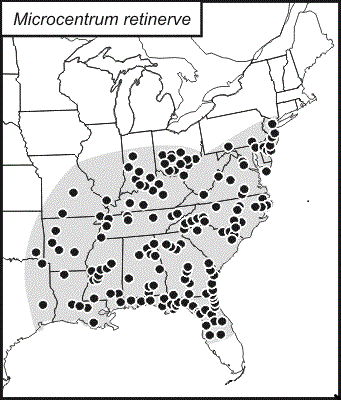
Lesser Angle-wingeds (Microcentrum retinerve) are not supposed to be up here. They should be singing down in Columbus and south. I only knew the songs from my trips to southern Ohio. 


Did I have my recording equipment with me? No. Of course, I came back as soon as possible and recorded as best I could. It was a challenge, as they live up in the trees and I had to listen past the noise from the three freeways nearby.


What route had they taken north? Would I be able to trace them back to central Ohio? I wish I could tell you that I figured it out.


I drove all through Cuyahoga National Valley Park after dark on two subsequent nights, assuming it would be relatively easy to find my way around this extensive park. Not surprisingly, this was quite an unreasonable assumption. However, my pathetically disoriented nighttime rambling did turn up a Summit County Japanese Burrowing Cricket singing near Riverview Road.  

The Lesser Angle-wingeds seemed limited to the Peninsula area along Stine and Riverview Roads. The map below shows the four locations where they were singing in the trees.


The pioneers are definitely up here. With so many species are moving north, why shouldn’t Lesser Angle-wings begin to join their Greater Angle-wing cousins as they do in southern Ohio?


Discoveries and data, songs and surprises to be continued in 2020…

 Female Dusky-faced Meadow Katydid, Frohring Meadows